

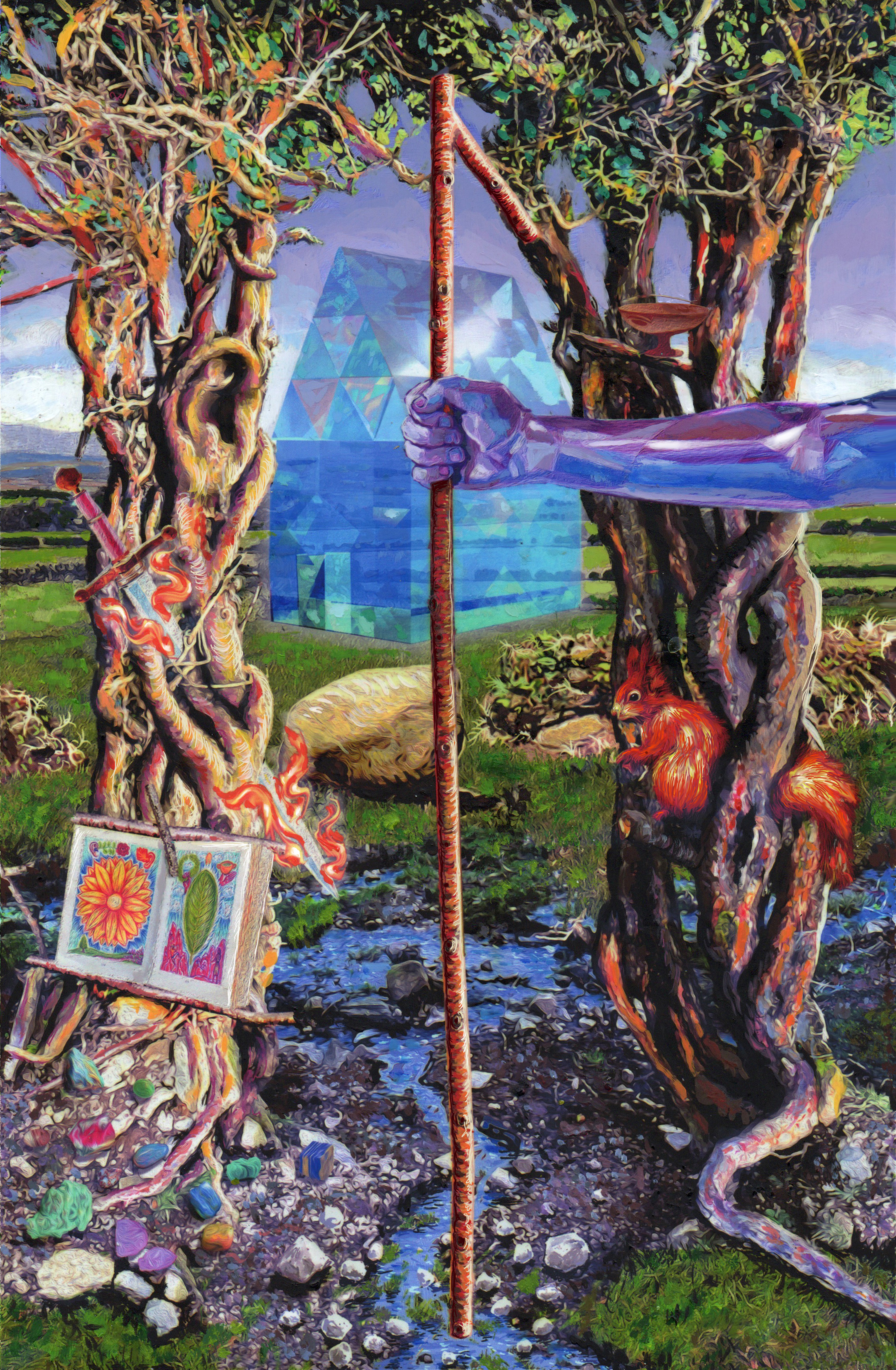
| Place | Painting No. | Date |
| Saint Colmcilles Well, Kells, County Meath | “(1PS)” | 1/4/23 |
| Spiritual/Esoteric ref | Gaeilge | Etymological Root |
| The Pilgrims Staff. The Staff of spiritual authority or/and sovereign power. The Druids Wand the kings sceptre. | Tobar Naomh Colmcille, Ceannanas | Tobar: can also mean mine, a depression or hole in the ground Ceanannas: Fair Hilltop? |
The Pilgrims Staff

Different time dreaming.
In Your Real World we fly
a sense of what comes
After we die .

A friendship grows
With that extended living
Why do some die,
depart gently giving?

Laying down the lie...
the worlds constant weight
With the last long sigh,
Passing The Earth Gate .

Shown the futile, reclining,
Black eyes and empty stare.
Kept in metal pens dying
Victims, sheep, bone-bare.

From the rolling cloud
Moving outward sounding
Spinning cumulus aloud
Thunder lightning pounding.

The Saviour of The Heart
Arms extended, embracing.
Came happily out forth
A rescue down descending.

Somehow lifted and freed
This weak thin spirit.
immobile, hamstrung. Believed
with grace, given credit.

Stepping upon the pathway
Of purple glassy stones ,
A mist forms around me
In twilight grey tones.

I saw in the mirror reflected
My true self portrayed.
Aura reluctantly accepted
Brown-orange-yellow haze

The ally alongside aware
They more keenly attuned
to the presence squared,
demons, foes… the ruined.

We fly on and I see
The sanctuary window bright
Tara's Hill , its reality,
The wooden refuge light.

Through the glowing door
In earthen circular embankment,
Luminous green height of lore
Protection ring, heaven-sent.

The distant trees shimmering
Few left now stand
Upon the outer verge ring,
This almost safe secluded land .

Shown the gentlest teaching
By Your Holy Beauty
Imparted like singing,
Imprinted I, healed, duly.

I journey now away
Your staff in my hand ,
A pilgrim on life’s day
To uncloak this strange land

As to why some die
Gently, gratefully giving?
It’s because of their heart-sigh.
Their passion led-by-You-living.

Sean O'Dwyer, August 2024
The idea behind the Knights of the Round Table can find their origins in the legends of The Red Branch Knights and their various quests. They meet mysterious young maidens and are offered sustenance from the Dagda’s cup which finds its equivalent in the “Grail” in medieval legends. The Sword is related to the Sword of Truth emanating from “The Mouth Of The Son Of Man” in St John’s Revelation and also in many stories about various swords along the way in Irish Myths and Arthurian legends. Also there is the Lia fáil. The stone upon which the Irish kings are crowned, the quintessential image of the Celtic megalith evolves as a symbol into the coin and becomes the currency of the realm. The image of sovereignty is also contained in shield of royalty which bears the king’s image in his arms .
Here we are looking at the symbolism of The Druids Staff or wand that from Celtic mythology evolves into the image of Merlin’s staff and can be equated with the Christian pilgrims staff. It finds a place today in the imagery of the church as the bishops crozier. But it also has another ancient reference as the knights lance or “spear of destiny”. Which also finds it ancient predecessor as The spear of Lugh. Here is outlined an observation upon the origins of these symbols…..
“The ‘Matière de Bretagne’ which formed the theme and incident of so much of medieval literature of the twelfth and early thirteenth centuries appears to hark back, at any rate in part, to a corpus of Celtic Myth and legend preserved in Ireland , Wales, and to some degree in Cornwall and cross fertilised by constant contact between indigenous populations ” (Page 10)
” The gods of the Irish Sagas had also certain treasures or talismans which could on occasion be seized or won by heroic adventurers to the other world : there was the stone of sovereignty , in which it is possible to see the prototype of “The Seat of Danger, the sword and lance already mentions and which appear though with a different history , in the Quest of The Holy Grail, and in the Welsh versions a platter or large shallow dish , apparently similar to Chrétien’s ‘Graal’, one of whose attributes was to furnish the feasting guests with whatever food they fancied” (Page 13) (P.M. Matarasso)
“The Quest of The Holy Grail ” Translated with an introduction by P. M. Matarasso, An extract from Page 10 and from Page 13, Penguin Books England, 1969
As it happens these fours symbols I refer to in these four essays also appear as the four suits of the Tarot cards. The suit of swords, wands, coins and cups. Which in turn find their way into modern playing cards. Clubs (as in sticks) are wands, diamonds are coins, hearts are cups, spades are swords. This is how an Irish traveller I once visited many years ago used ordinary playing cards, rather than a tarot deck to tell my fortune . The cards became a vehicle for the oracle, the fortune-teller, to use their psychic abilities to receive guidance from spirits she was listening to whether they be evil or good and their understanding of the plain deck of cards is actually rooted I. The symbolism of the tarot.
These images relate directly to the four treasures of the “Tuatha Dé Dannan “ the mysterious mystical tribe of the People of The God Dannan who bring with them these four treasures from the four mysterious island cities … Murias, Falias, Gorias and Findias, in the north.
The Origins of The Pilgrims Staff
It is patently clear particularly with the image of Merlin that his origins are to be found with the wand wielding Druid whose wand comes in the form of a wooden staff. Merlin is the advisor to King Arthur, this follows the Celtic legends where all young red branch knights are taught by their Druidic teachers and their trainers. with his exclamations, what Merlin does is echo the teaching of the Druids. He brings the young Arthur to nature to learn what he needs to know and uses shapeshifting magic to transform him into various creatures during his training.
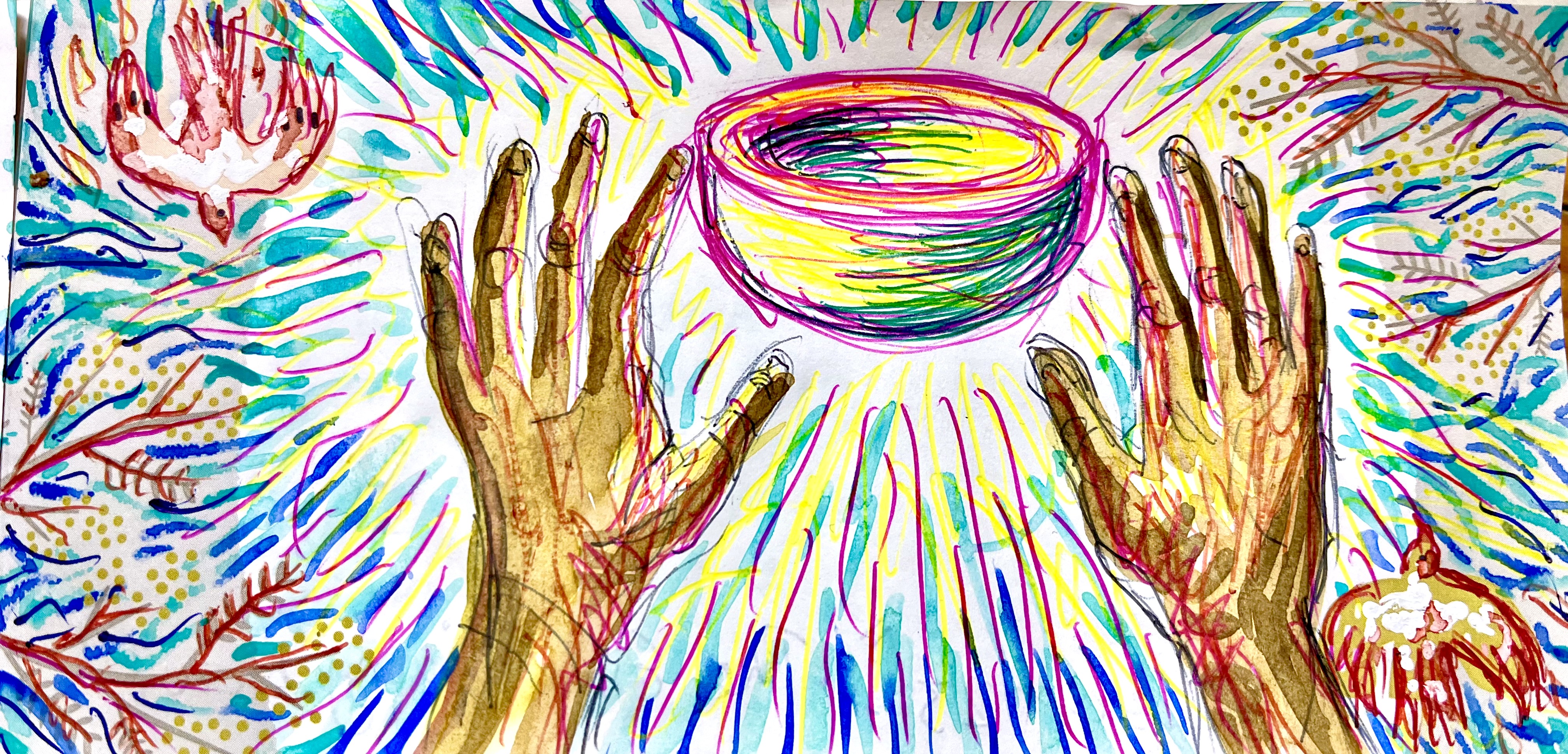
This takes place in the forest amongst the trees that are effectively the Druids university, where all the attributes of herbs and plants can be learned where the creatures teach us the movements of working with elemental energies. He shape shifts the young Arthur into different creatures so he can learn about life. This shapeshifting is common in Celtic legends such as the story of Etain who is turned into a fly or the red branch knight who is turned into a pig (Brilliantly elaborated on by TH Whyte in “The Once and Future King”). The teachings from the living forest are… that if you understand what makes nature work, you can apply this to what makes humanity work. This of course was also well known to the teachers of the oriental martial arts. No doubt it was the same for the celtic warrior elite.
A Motivating Belief System
It was said that the Druids hid their magical knowledge in the ancient mounds. They may have schooled their apprentices there too. Whether you believe this to be true or false, belief in this idea was enough to draw the British Israelites society to the Rath of the Synods at Tara to dig it up between 1899 and 1902 to look for the Ark of the Covenant which they believed was buried there. Certainly the carvings on the stones at these sites do contain knowledge… and Martin Brennan was one of the first to propose that this knowledge is about the orientation of the earth, measuring seasons , the sun, the moon, the planets and the stars. Brennan is important because he realised that the megalithic builders were actually scientists recording their celestial observations. He writes about this in in books such as “The Boyne Valley Vision”, (Dolmen Press, 1980)
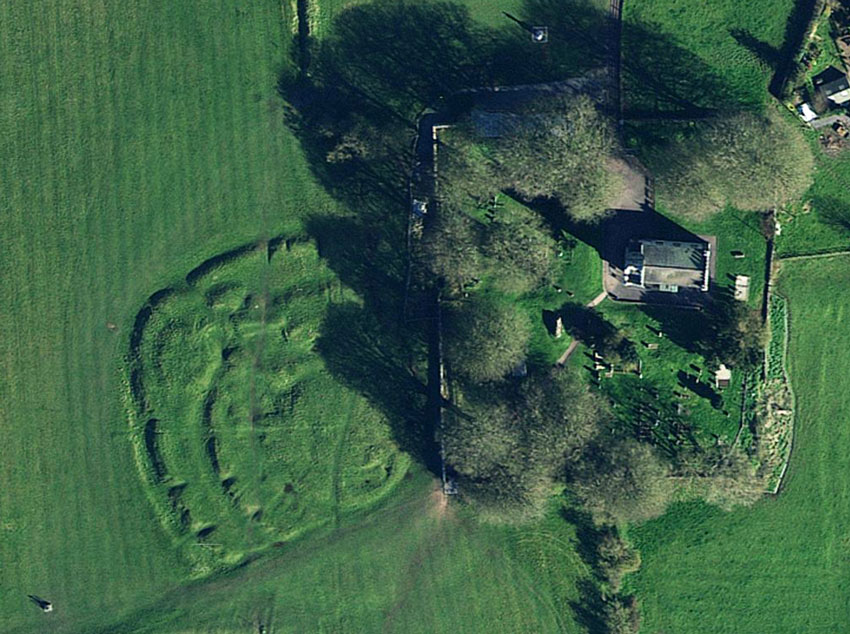
“And lest one decide that the entire folly was confined to the English, the British-Israel Association of Ireland was founded, on March 17th, 1897, in the Leinster Lecture Hall, Molesworth St, Dublin. Freemasonry provides another strand to the tale particularly as the Ark was the common symbol for the British-Israelites and Freemasons. If the core of British-Israelite beliefs were based on Protestantism, Freemasonry was, and remains, interdenominational.” https://www.newgrange.com/tara-ark-of-the-covenant.htm
The gaping remains of the gouged rath caused by the British Israelite dig can still be seen to this day. Despite the protestations of significant Irish figures such as Yeat’s, Gonne and Moore(They wrote a letter of complaint to The Times in London). Perhaps this was also the hidden reason why the Royal Society dynamited Dowth in 1847 in the middle of the worst year of the Irish famine known as Black 47 ? Were they looking for the same thing or some other lost treasure? It seemed to be a most unusual time selected to do such a thing . Why? They must have believed something, some type of treasure lay hidden there….. and if they ever found it , would we ever learn of what it was they found ? Perhaps they believed no one would object to a raid being conducted upon Irelands pre-historic treasure in the middle of a genocidal famine which itself was a raid on Irelands resources also, caused deliberately by the removal of all of its livestock and food through Irelands ports over to England ?
Tara and the Ark of the Covenant: A Search for the Ark of the Covenant by British Israelites on the Hill of Tara (1899 – 1902) Mairéad Carew. Royal Irish Academy 2003
The Four Treasures And Their Lasting Imagery
What is clear is that once you examine the images of the four treasures of The Tuatha Dé Dannan, what you find is that they are mentioned early in the writings and translations of Lady Gregory who also seems to be aware of their link to images within the four suits of the Tarot . When I say early in her writings… I literally mean the very first page of Book One of her substantial opus ‘Irish Mythology’
“It was in a mist the Tuatha Dé Dannan the people of the gods of Dana , or as some called them , the men of Dea , came through the air and the high air to Ireland. It was from the north they came; and the place they came from they had four cities….…. And they brought with them from this four cities their four treasures :
- A stone of Virtue from Falias, that was called the Lia Fail, the stone of Destiny:
- And from Gorias they brought a sword :
- And from Finias a Spear of Victory:
- And from Murias the fourth treasure, the Cauldron that no company ever went away from unsatisfied . “
Lady Gregory’s Complete Irish Mythology Book 1 The Coming of The Tuatara de Danann: Lady Augusta Gregory, Bounty Books 2014 edition
___________
The Esoteric Meanings behind The Staff.
W.B. Yeats, who wrote a forward to Lady Gregory’s Irish Mythology was also aware of the importance of teh symbolism of the staff or wand and the mention of it as one of the four treasures of Ireland at the beginning of her translation. Also he would have been taught about the importance of its symbolism during his magical training as a member of the Golden Dawn. Yeats notebooks of his training in these matters were given in part to him by his uncle George Pollexfen (1839 – 1910). As we know of course, Yeats poems drew a great deal of inspiration from Irish myths and legends. I’ve already mentioned Yeat’s book named after it’s second poem in the collection entitled “The Tower “ (see section on The Tower of Dowth), published in 1928 after he became a Nobel Laureate, it shows a very tangible connection with the legend of The Tower of Dowth and the tower that was to become his home The Thoor Ballylee.
It all sounds and looks like something straight out of Harry Potter. But then Rowling’s books were the result themselves of research into various real-life forms of magical practice. Numerous references within Rowlings books example the references to and Theosophy the magical religious system made popular by Helena Blavatsky at the turn of the last century are….
“…..also interpretable in or, to use J. R. R. Tolkien’s term, “applicable” to other contexts, such as Theosophy, with which Rowling has some familiarity, as is clear from her reference in Harry Potter and the Prisoner of Azkaban to the fictitious author “Cassandra Vablatsky” and her equally fictitious book Unfogging the Future. “Vablatsky” is a metathesis of “Blavatsky,” and “Cassandra” is an appropriate substitute for Helena, because Cassandra was the daughter of Priam, King of Troy, a prophetess who always spoke the truth but was never believed and because Cassandra’s story is part of the great war of the Iliad, fought over Helen. Moreover, the fictitious book title “Unfogging the Future” suggests Isis Unveiled, Helena Blavatsky’s first major work.”
(Originally printed in the November -December 2002 issue of Quest magazine. Citation: Algeo, John. “Harry Potter and the Ancient Wisdom.” Quest 90.6 (SEPTEMBER – OCTOBER 2002):220 – 225.)
and some ideas in her stories are drawn from magical thinking that still resides in sovereign politics as discussed below.
The abundant evidence of Yeat’s magical practice is contained in the Irish National Archive and was publicly exhibited there in recent years.
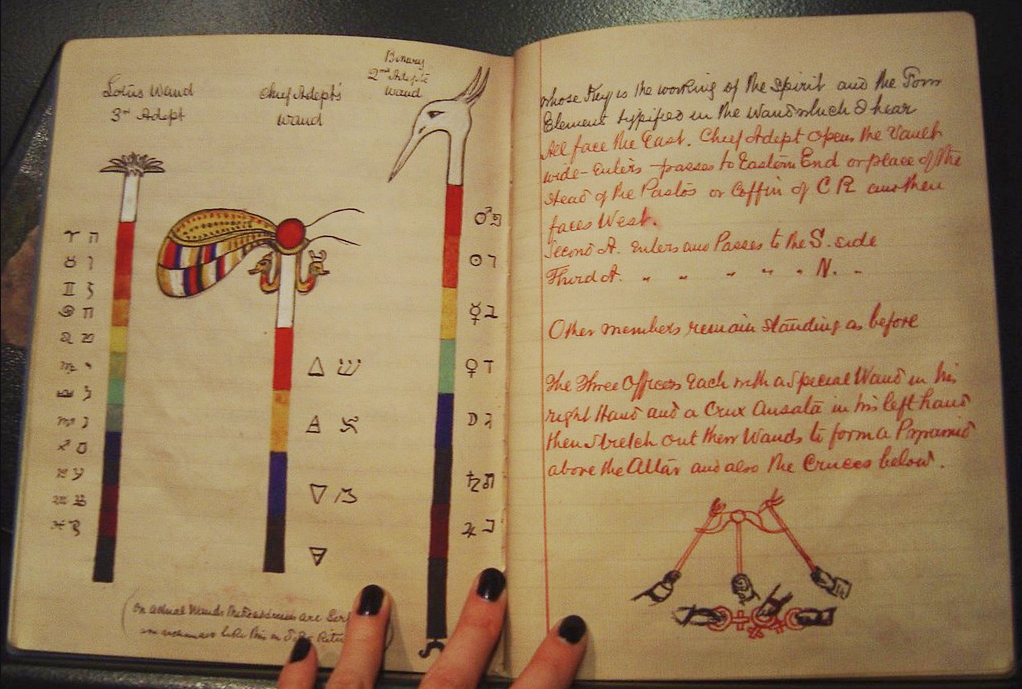
The Golden Dawn Notebooks of WB Yeats National Archive Dublin
You might think that magical and mystical thinking does not have a bearing upon us any longer and that the legends of The Grail no longer affects our daily lives. If so, I would beg to differ.
Let me furnish you with two examples that are especially relevant in the last couple of months. When Queen Elizabeth II died the year that this essay was first begun in 2022. An odd and usually private magical ritual was shown to the public for the first time ever. After her coffin was paraded through the streets, a tradition that dates back centuries, at least to the 1300’s, was quietly played out just before the queens coffin was lowered into the crypt.

The wand of office was said to be a tool used by the Lord Chamberlain as a sign of his authority wielded over others at court. He would actually tap courtiers with it if they were too “boisterous”.
During the ceremony at the end of the funeral his wand was solemnly broken in half and laid upon the queens coffin by the lord Chamberlain as he stands in front of King Charles. What did this mean? The Lord Chamberlain was Baron Parker who, as it happened, was also the Director General of MI5 from 2013 until 2020. “Breaking the wand” (in the ceremony, it is actually unscrewed in half) is meant to signify the end of the Lord Chamberlains representation of her majesty in Parliament due to her death. The breaking of the wand symbolizes the end of the queens power over temporal events. So the wand held real power during her lifetime. Of course it must be remembered too that she was head of the Church of England also. So the wand signified spiritual power too.
Like a scene out of a magical fantasy The rod being broken in half tallies perfectly with the character of Harry Potter breaking the all powerful elder wand at the end of the movies based on Rowling’s books. Was Rowling making a direct reference to the symbol of power…. and ultimately a magical meaning… that the Lord Chamberlains wand represents? I have found that Rowlings books contain more than one historical reference like this.

And why was a very esoteric ceremony shown to the public on TV? Like most things, it has an outer and an inner meaning. Perhaps we should start questioning this symbolism, especially that inner meaning?
From A Wand To A Rod And A Staff.
In Ireland there was also “ White Rod ” slat an Righe , the rod of kingship or slat tighearnais ,rod of lordship ( I see the word “Tigh” meaning “house’ in there perhaps meaning “house” as in sovereignty and earnais, as in wealth, the wealth of the house ). It was the symbol of sovereignty up until the 17th century when it is replaced by the English Black Rod in 1707 (not the same thing as the “Wand of Office” mentioned above, that’s a different position held by an English public servant ) until the creation of the Irish Free State in 1922. So the idea of the rod is not just english in origin. Far from it.
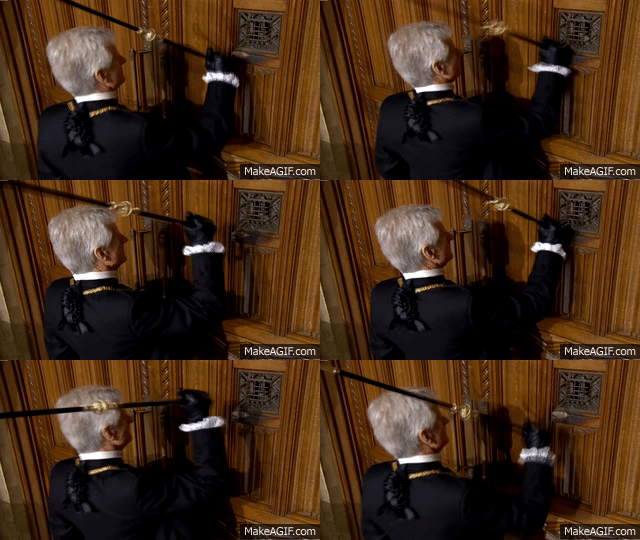
Still in England today “The Usher of Black Rod” who’s office was instituted in England in 1361 and who is a “Knight of the Garter” has the doors ceremoniously slammed in his face and he must knock on the door three times to be let in . This is to emphasise the hard-won independence of the House of Commons from the sovereign. This symbolism arose as a result of events in 1642 at the start of the First English Civil War when King Charles the first, attempted to arrest 5 members and “Black Rod” was refused automatic entry from that time on he always need to knock to be allowed to enter.

In this imagery, the wand has almost the same symbolism as a sceptre and its symbolism representing sovereignty goes back to ancient history in almost all cultures. A bishops crozier or a saints staff evokes power in another but closely related way. In the case of the bishop this power goes back to the first Bishop Peter by apostolic succession. Clearly this was done to absorb the earlier pagan associations into its newer Christian imagery. It may also be a Jewish influence on early Christianity from the staff that the High Priest of the Temple at Jerusalem held, instituted by King Solomon.
An Irish Link To An English Magician.
The links between the crown and the practice of magic go back a long way but they really come to the fore in Elizabethan times . Queen Elizabeth, the first that is, had famous advisors in this area, they were John Dee and Edward Kelley also known as Talbot .
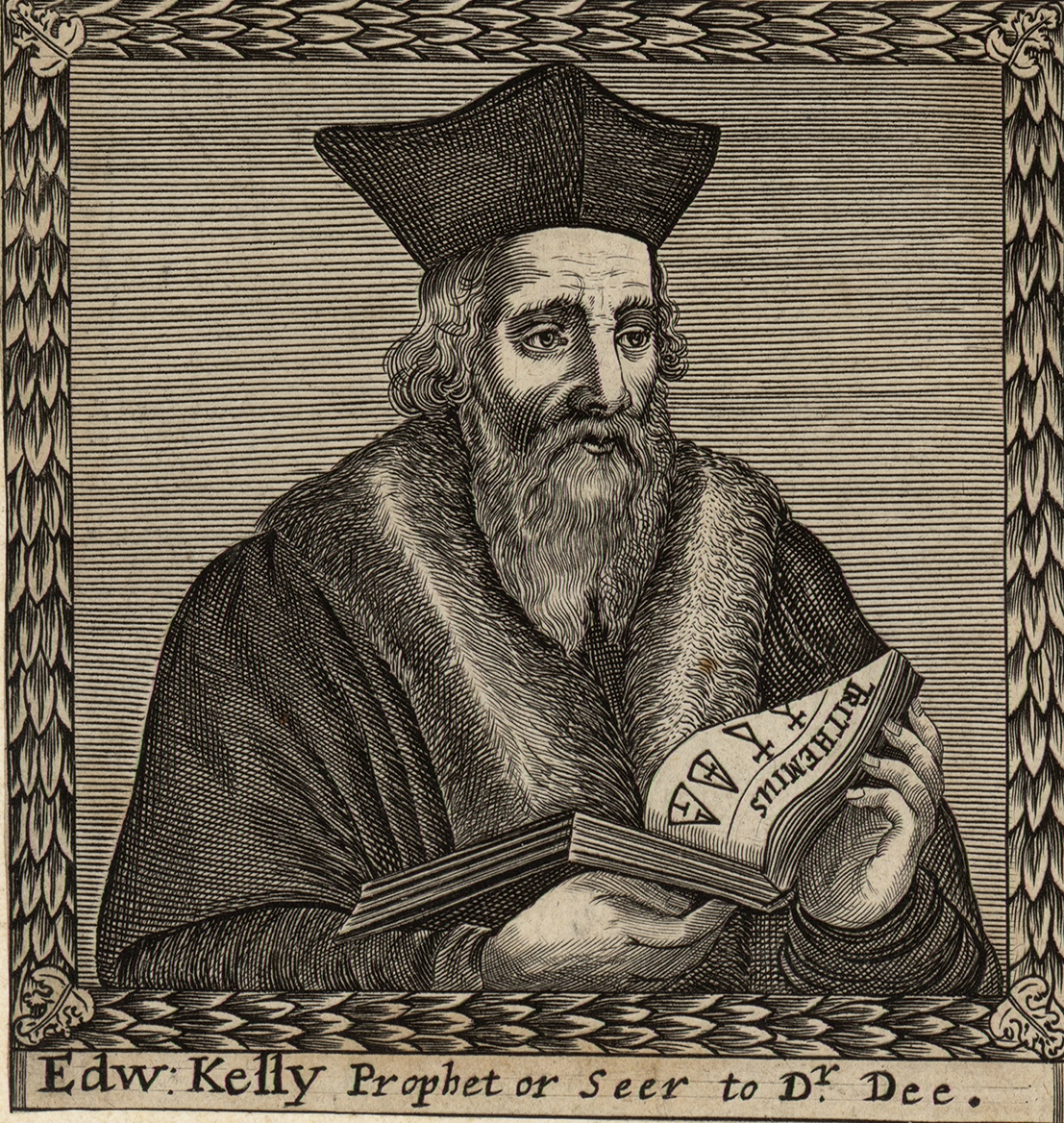
Kelley claimed to have descent from the Uí Mhaine (“Hy Many” in English, modernised as O’Mahony ) family in Connaught, Ireland. This family controlled a thousand square miles of the area and was one of the oldest known families in Ireland claiming inheritance there since 357 AD. Numerous O’ Kelly, Kelly, Ó’ Ceallaigh families still inherit the name from this clan today. He himself was born in Worchester in 1555 and was a known occultist, medium , a “scryer” (Someone who looks in dark mirrors or crystal balls to see spirits or knowledge ) and he was what we might call today, a psychic and a practising magician.
He claimed to be able to speak with the angels and hold “conferences” with them. Today we might refer to that as a seance, though it is still quite a different thing…. speaking with angels rather than specifically the spirits of the dead. Dee and Kelley were essentially seen as Elizabeth’s spies and their maneuverings and influence represented the intelligence service of its day serving the crown “On Her Majesty’s Secret Service”. Dee used to sign his letters to Elizabeth ‘007’……. I’m not making that up. Ian Fleming, a member of the British Intelligence Services himself at one time may have taken it from his research into Dee.
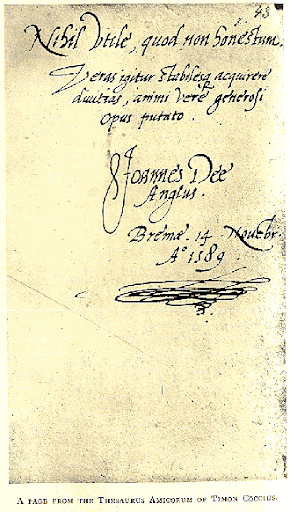
The double O’s represented the eyes of The Queen and the long 7 disguised in the way he wrote his “J”, the first letter of his name, was used by Dee to signify himself, as the number had alchemical meaning for him . ….and so we get the phrase “For Her Eyes Only”. Though this might be a free interpretation of Dee’s Signature while it looks like an infinity symbol “8” alongside at the J of his first name written like a ‘7″. You will have to make up your own mind. But some of the images I have seen of the double O with the elongated top of the 7 seem to come from sigils taken from grimoires. However, the links between the occult and the world’s intelligence services goes back a long, long way. The intelligence services are literally occult after all.
The Egyptian Origins Of The Imagery Connected With The Staff
And so we come in time to the Christian equivalent of the druids staff. A bishops crozier. One aspect of the roots of this symbolism can be found in the Bible itself and this refers to Egyptian culture where the rod or sceptre was an powerful symbol held in the hands of the pharaoh as we see depicted very often in Egyptian Art. But the Christian roots of the imagery refers to Moses who of course lived as an Egyptian and… if we look closely at the historical origins of his legend, he may have been at a forefront of a movement to try and bring monotheism to Egypt. I have come to believe that this story is related in research to Akhenaten the father of the famous Tutankhamun.
He was known in the first years of his reign as as Amenhotep IV and was married to the beautiful Nefertiti. The reason he changed his name was to indicate that he urged the Egyptian people to follow one God only when he chose to become monotheistic . He called this God ‘Aten’ and this God was symbolized by a sun disk. It seems obvious to me that this is a clue as to what might be the actual truth behind the story of Moses. In the writings of Brian Cleeve (See The Seven Mansions Watkins 1980 ) he states that this is the true story behind Tutmoses. Tutmoses is a name which appears twice given to the pharaohs of same bloodline of Amonhtep IV (who as I said , changed his name to Akhenaten) showing it is not unusual for familial names to be passed on to younger generations . In this understanding of history Tutmoses was the physician and teacher of Akhenaten. Tutmoses was the adopted prince found in a reed basket by the pharaohs daughter and adopted into the royal house. When he grew up Tutmoses learned of God’s revelation teaching that there was only one True God The creator 0f all things , that some priests still believed. He taught these revelations to Akenaten . But his opposed the pantheistic belief in a group of Gods that the Egyptians worshipped. This is the historic story related to us in the Bible that we have received a garbled version of . In that Bible legend It is generally believed that the pharaoh in this story is Ramses II. But it is convincing that this story has its true historical basis in part in the story that we know of from historical record about Akhenaten. You would have to admit that is likely at least that the two stories are connected.
The Seven Mansions: Brian Cleeve, Watkins 1980
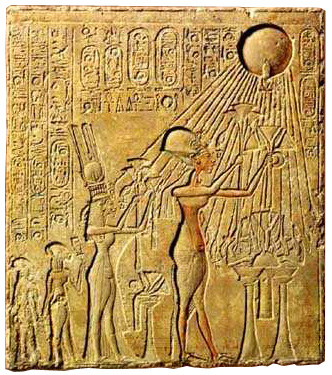
An Egyptian Montheistic Religion Instituted By Akhenaten.
As I said. In the historical record, Akhenaten (who reigned from about 1353 to 1334 BC the tenth ruler of the eighteenth Dynasty) came to believe that there is only one God and he attempted to force this different teaching upon all of Egypt. By doing so, Akhenaten caused friction between himself and the priests and brought Egypt to near ruin. Events reached a head and when the priests that opposed his ideas successfully rose up with the support of the people against him. Akhenaten eventually committed suicide along with many members of his family as Egyptian royalty of that time would be expected to do in the face of such overwhelming opposition. Tutankhamun for a short time lived to undo his father’s works… and this is why many of the temples created during his father’s reign were defaced. Tutmoses narrowly escaped into the deserts of Sinai with a few of his companions. In the writings of Brian Cleeve he states it is there that God revealed himself to him and made him a Teacher of Righteousness asking him to teach about what he had learned of two revelations from God, taught to previous teachers of righteousness from whom Tutmoses had learned what he understood up to that point. He asked him to teach it to the freed slaves of the chosen people who up to that time were slaves to the Egyptians. These were the same revelations Tutmoses also taught to Akhenaten. He was also asked by God to teach it to the Bedouin Shepard tribes who were related to the Hyksos who were known as The Khabiru. From then on, God told him, they were to be known as the Israelites and Tutmoses was to be known as Moses.
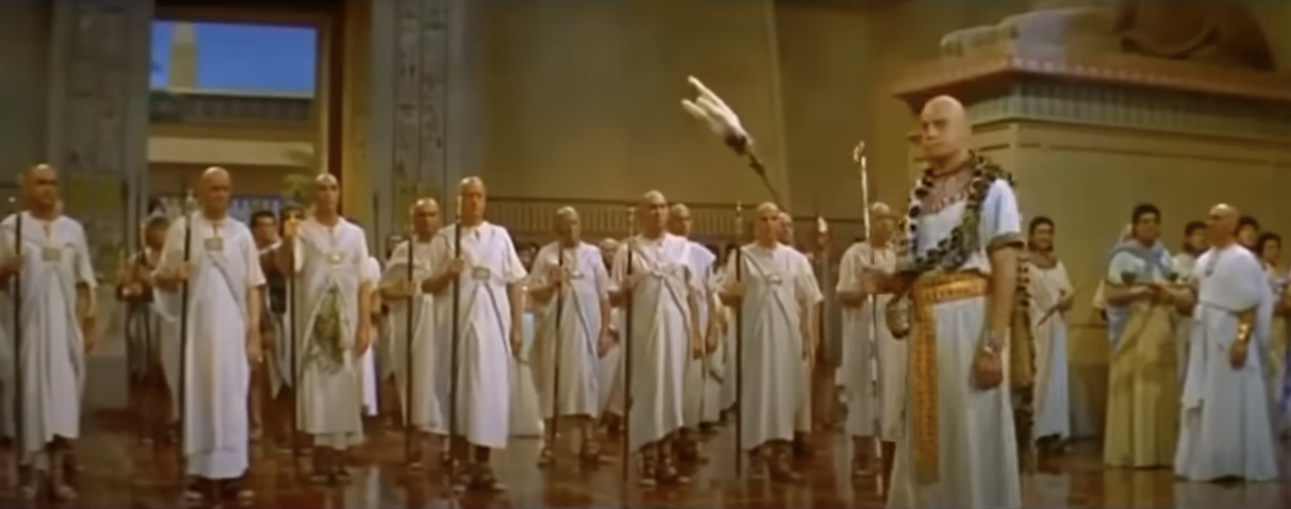
Although it is of lesser importance than the ideas above. The story of The Wand or staff is interwoven with Moses. The Bible stories relate that Moses asked Aaron to throw down his staff to persuade the pharaoh of his power by transforming it into a serpent. When the Egyptian priests did the same his serpent ate up all the others. This episode may hide a reference to the idea that the monotheistic God of the religion that Moses taught would “eat up” or essentially destroy the many gods of the polytheistic religion of the Egyptian priests. It may also reveal that Moses was seen as well as a healer or physician. In the Bible narrative he also used his staff to strike the rock and bring water to the Israelites who were desperate for water. He also used it to separate the Dead Sea. However The Truth behind these biblical legends should be explored carefully to find their true meaning so you can form an opinion for yourself as to what that Truth is. But in my defence of this idea about Akhenaten , it is far from new and people have known about it for a long time . There is a book created in 1945 which has a version of this idea in The Egyptian (Sinuhe the Egyptian ) written by Mika Waltari this book was later made into hollywood film The Egyptian in 1954. This is available at the moment at the link here… The Egyptian
Exodus 7 : 8-13 The Jerusalem Bible, Darton Longman and Todd Ltd 1974

The Staff and The Serpent.
The image of a rod with two serpents entwined around it appears in images of mercury and his greek equivalent Hermes who holds this device known as a caduceus. Sometimes the staff also has wings Perhaps conflating with the imagery of Hermes who has winged sandals . Did the Bible writers know of this other aspect of meaning. Was it placed there to make the christianised version of the Old Testament appealing to Mediterranean based mystery cults?
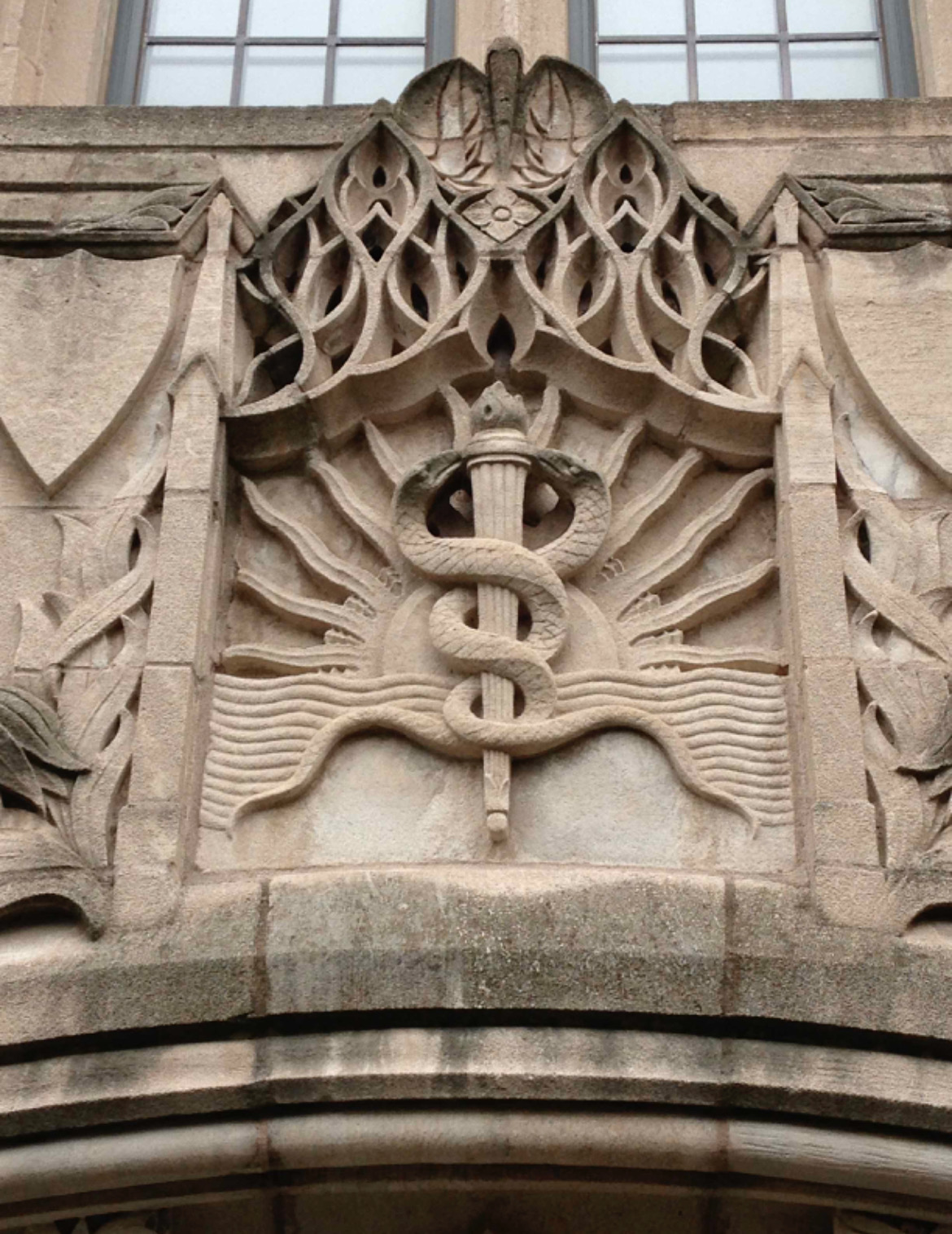
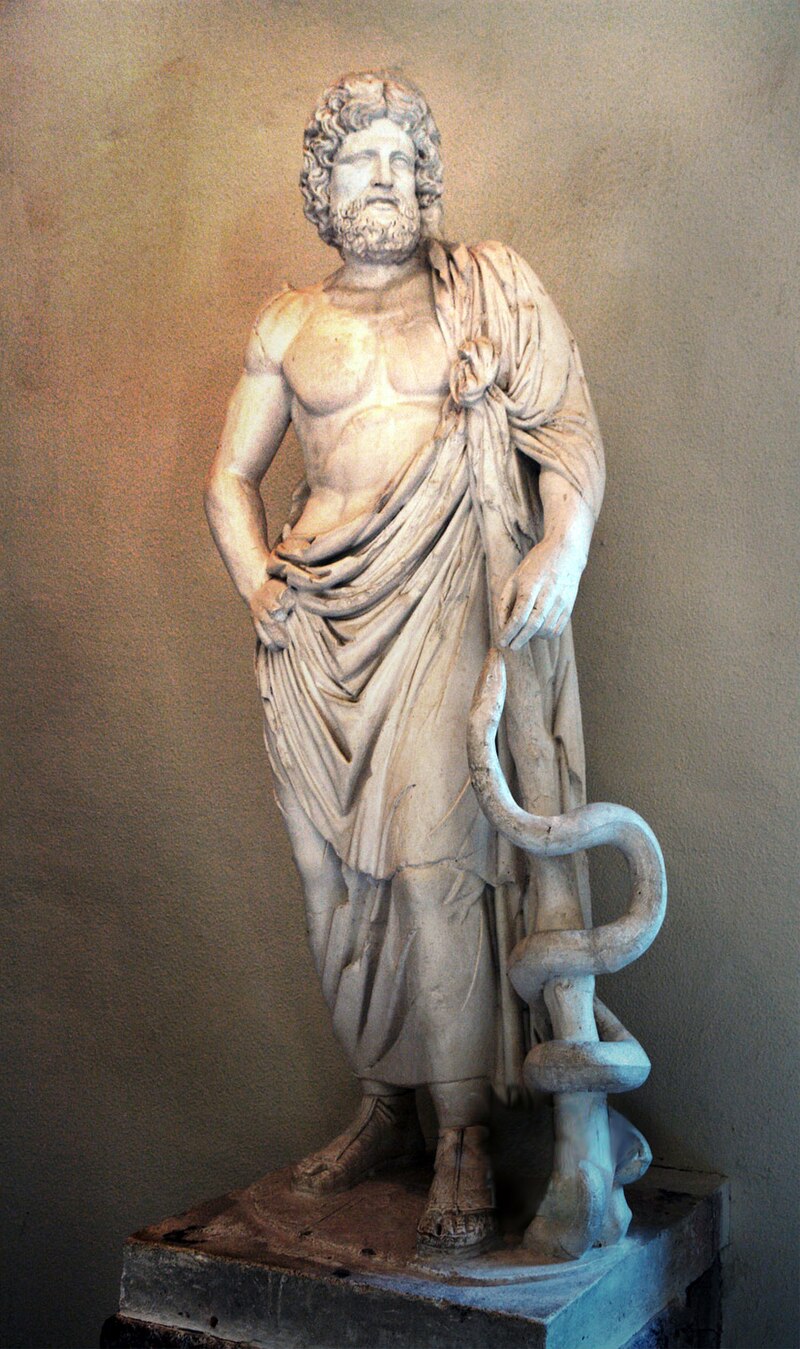
Another similar image is the Rod of Asclepius that has only one snake entwined about it and is better known as a symbol for pharmacists and doctors today. This symbol is partly founded in the idea that the Greek mystery cults surrounding the god Asclepius used snakes in their healing arts. It was at one of these centers that Hippocrates the father of medicine was believed to have practiced. The original version of the Hippocratic oath that doctors take still today, included a reference to Apollo the healer and Asclepius.

——————-
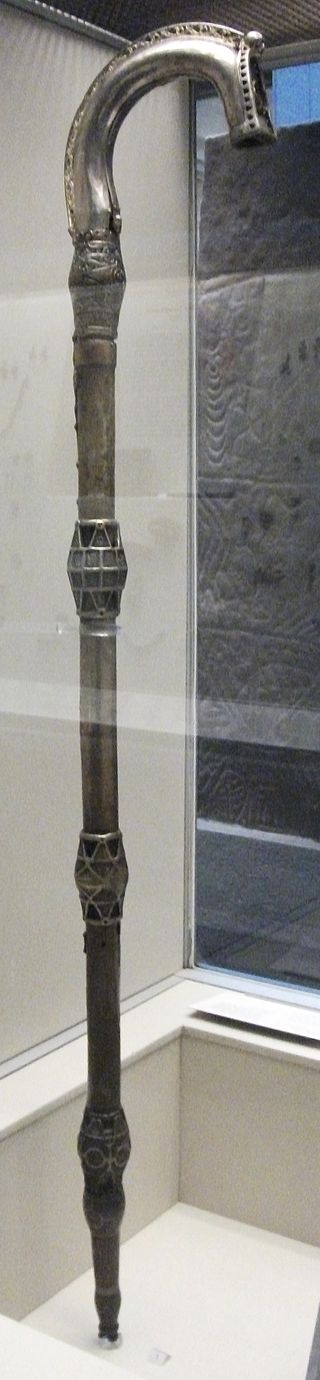
The Pilgrims Staff At Kells
I came across the image of the Staff again during 2020 when I visited Kells wondering if there was an ancient site associated with it. It appears as a place along the Crystal path although not as a juncture between two paths. Nevertheless I was surprised to learn that there was a large rath at this site which is generally not known to the public and is on private land. It is this view that became the backdrop for my own rendition of Kells for this project. I never heard of its existence until I found it by walking behind a most unusual folly built in 1791 called The Spire of Lloyd.
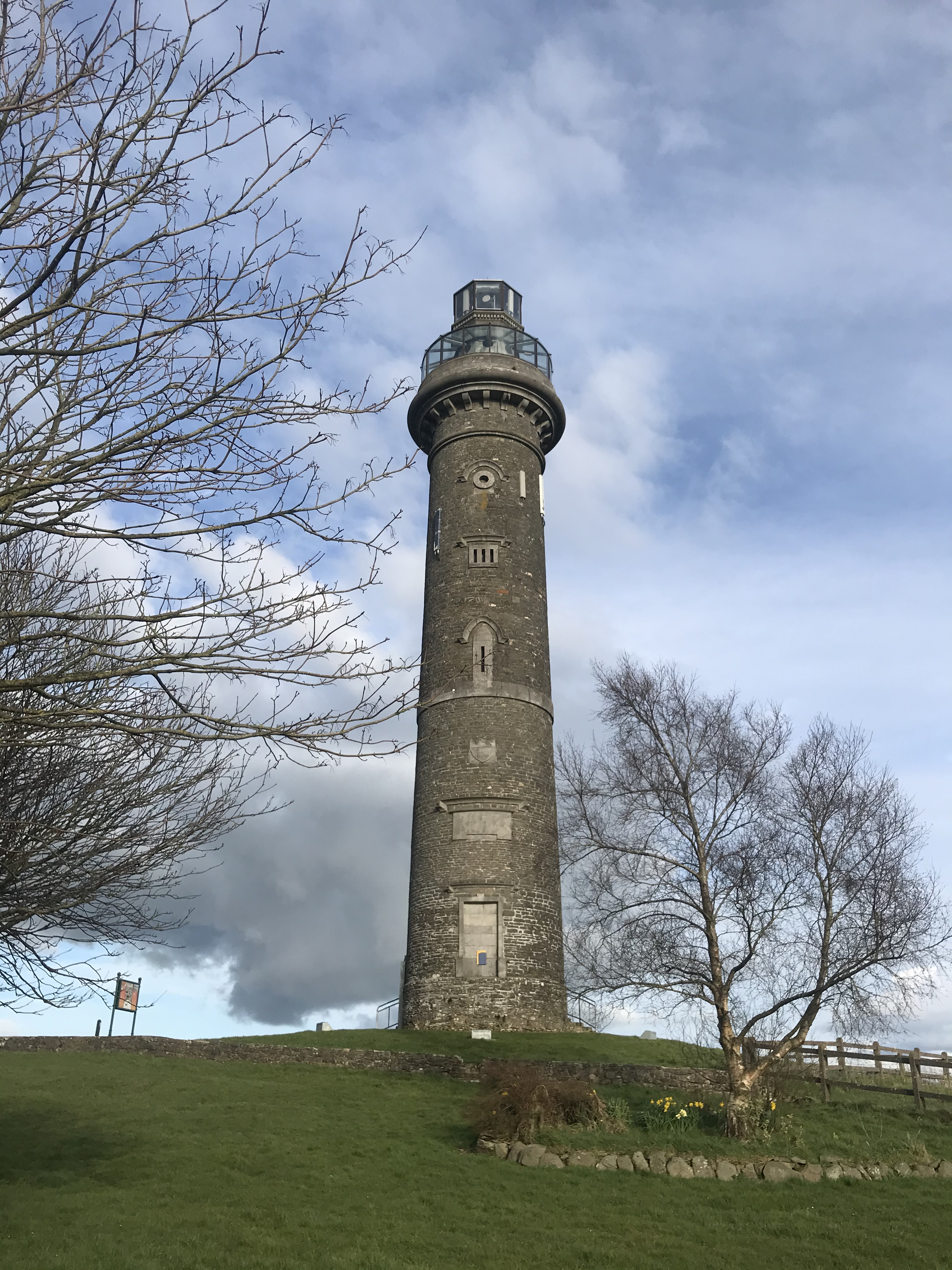
This itself is built on another ancient mound , a massive hill fort of concentric ditches originally named as the large Bronze Age fort called Mullach Aiti. The name Lloyd where the builder and landlord got his name comes from an anglicised version of this place name “Mulloyde”. The other lesser known hill fort may be part of this forgotten complex.
This place is mentioned in the Táin Bo Cuailinge when Maeve camps there on her journey across Ireland. I had not realised that Kells was such an important pre-Christian as well as an important early Christian centre. No doubt there is a reason for this, yet another sign that the transition between the two belief systems was ideologically smooth in some way.
Rathbrack (meaning, The Speckled Rath) is viewed further on from the mound the spire is upon .
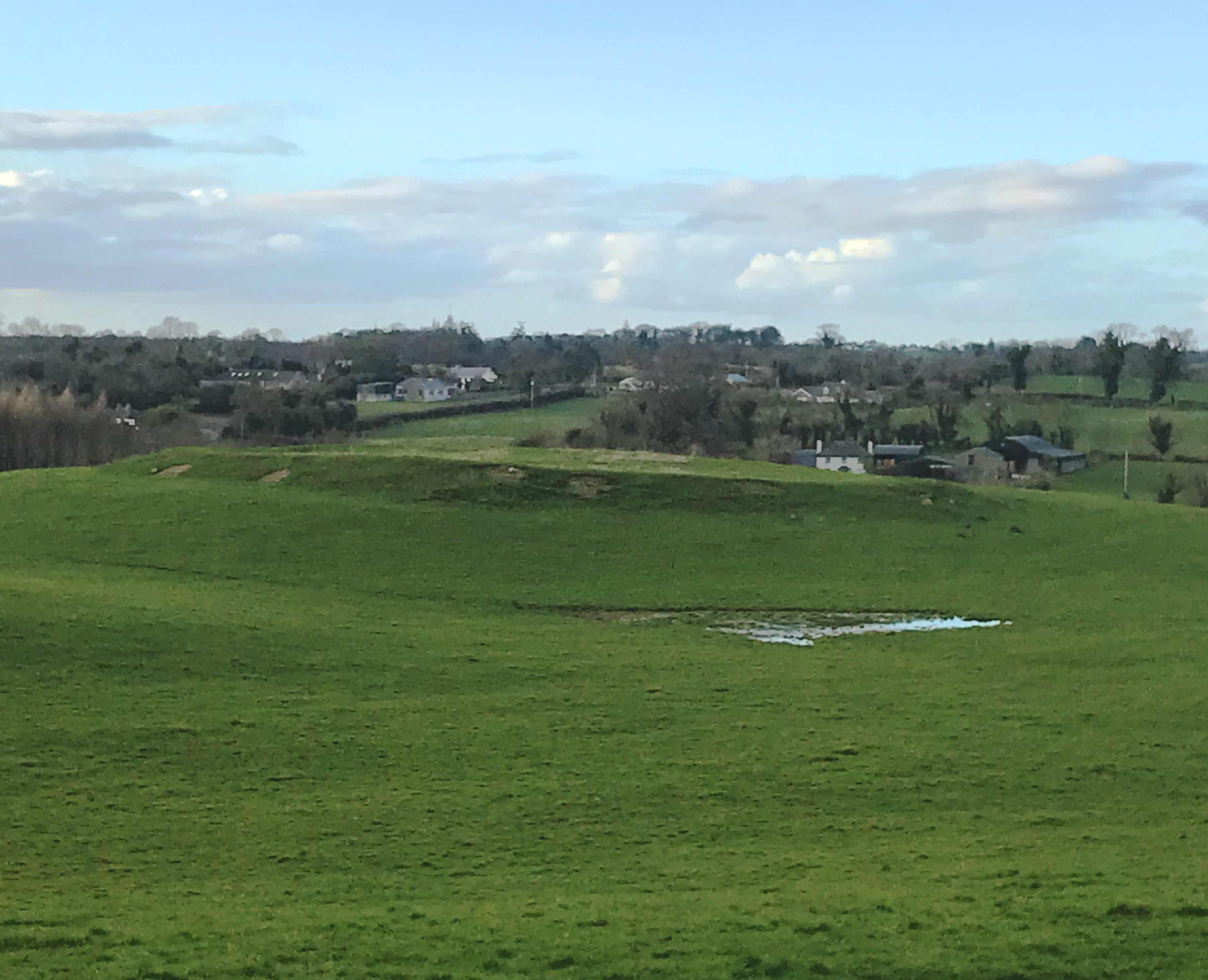
In 1314 Edward Bruce, brother of Robert the Bruce camped there during his failed attempt to invade Ireland at The Battle of Kells. Like nearly all history from Celtic to medieval times none of this was ever mentioned when I was at school and it is brand new news to me.
The Figure Of Jesus Enthroned Connected with The Imagery Of The Staff.
Many people are familiar with the Book of Kells. Also known as the Book of Columba . As it happens I helped to create digital media images of it for Trinity College (where the book is on display) in 1999 for a web company called “Xcommunications” that I did some work for back then. I was most fortunate to get a look at every hi-definition (for the time) photo of the pages of that book close up. I could zoom in to every single high resolution detail. It is clear to me that the tiny images contain meaning that go beyond an illustration of the gospels. It is often a mistake that’s made… to interpret the imagery as merely decorative or purely religious.
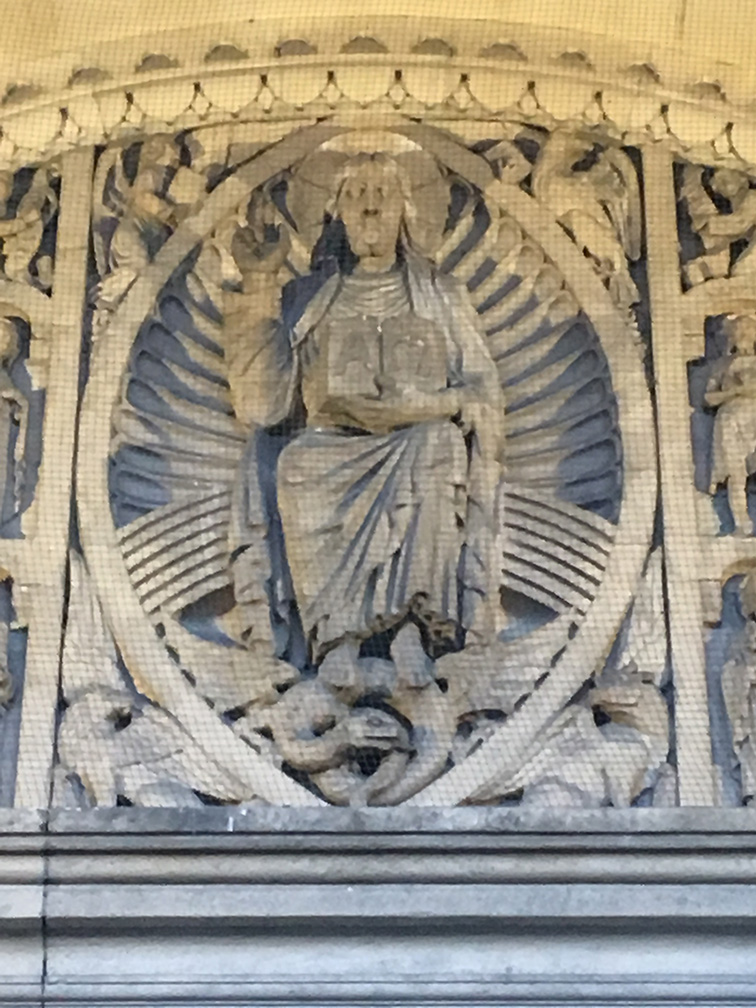
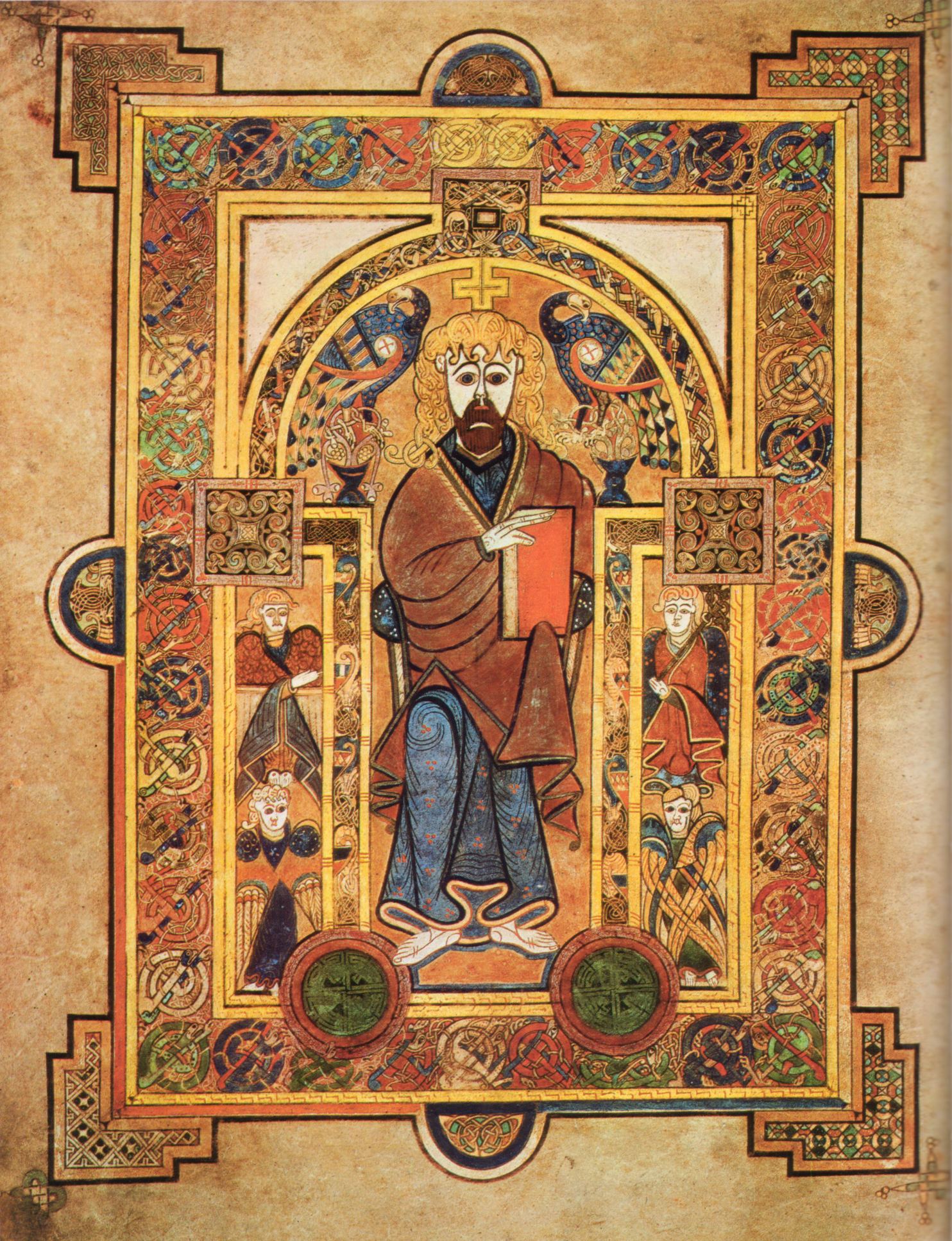
For example one of the the most well known images from that book the image of “Christ Enthroned ” uses the Golden Section an undergeometrical structure for the page. Many images are based upon well developed Geometry. This is actually a form of visual mathematics and upon closer examination also reveals an understanding of symbolism, numerology and astrology. I will cover the importance of geometry in another entry elsewhere.
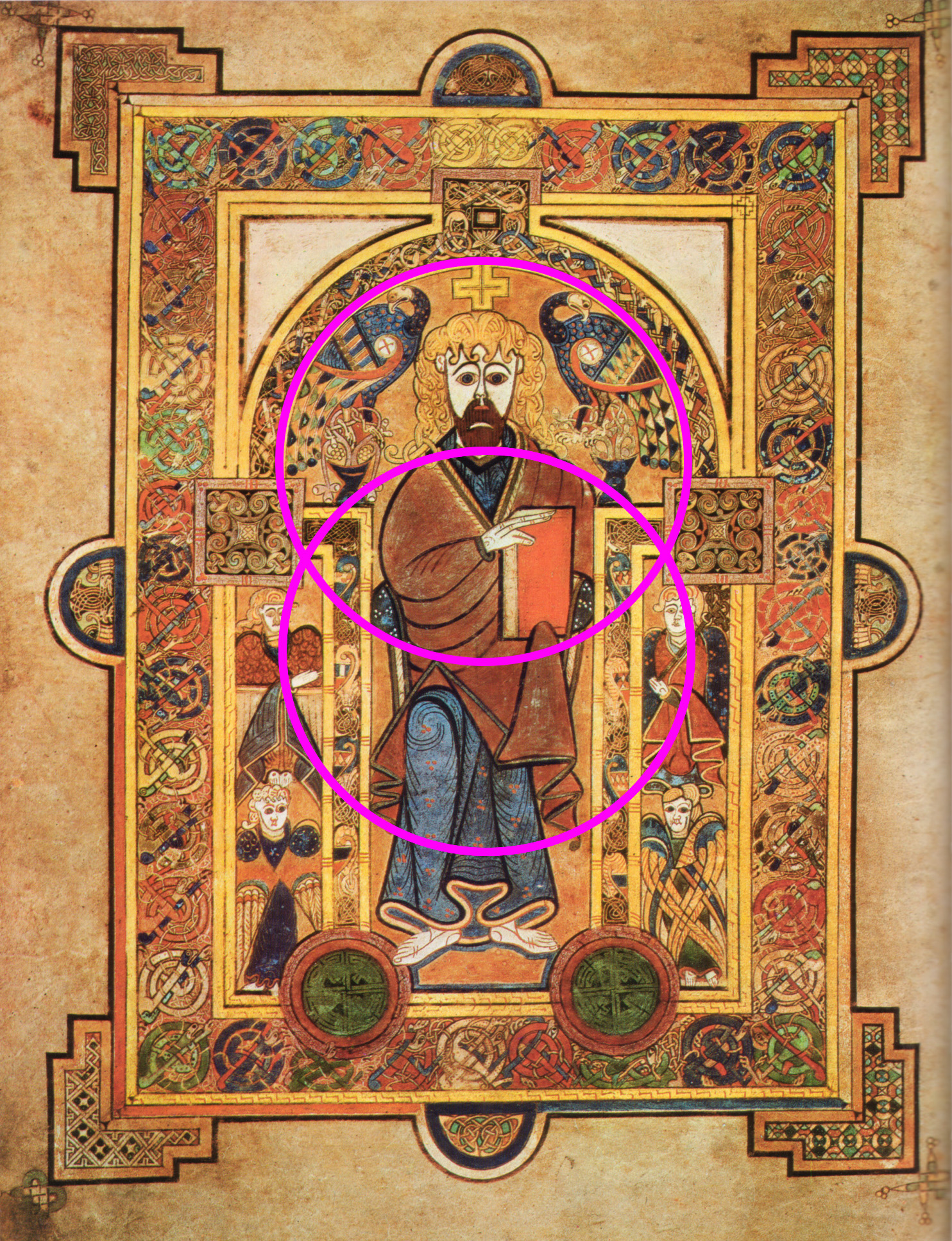
Geometry With A Story
But looking closer at the book if you were to try and copy the designs you would find out quickly that the designs were based on established geometric forms such as square grids containing circles or a Vesica Piscis to take just one example. Literally meaning the bladder of the fish because of the fish shape that is created when two circles overlap each other, in school we used to refer to them as Venn Diagrams. That was an early clue to me about the designs power. When looking at this design and its central motif we find it is in other places besides the book of Kells such as in the tympanum of cathedrals.
There its central shape houses the figure of Jesus usually appearing in glory. It’s form of course being fish shape is ideal. The reason is this…
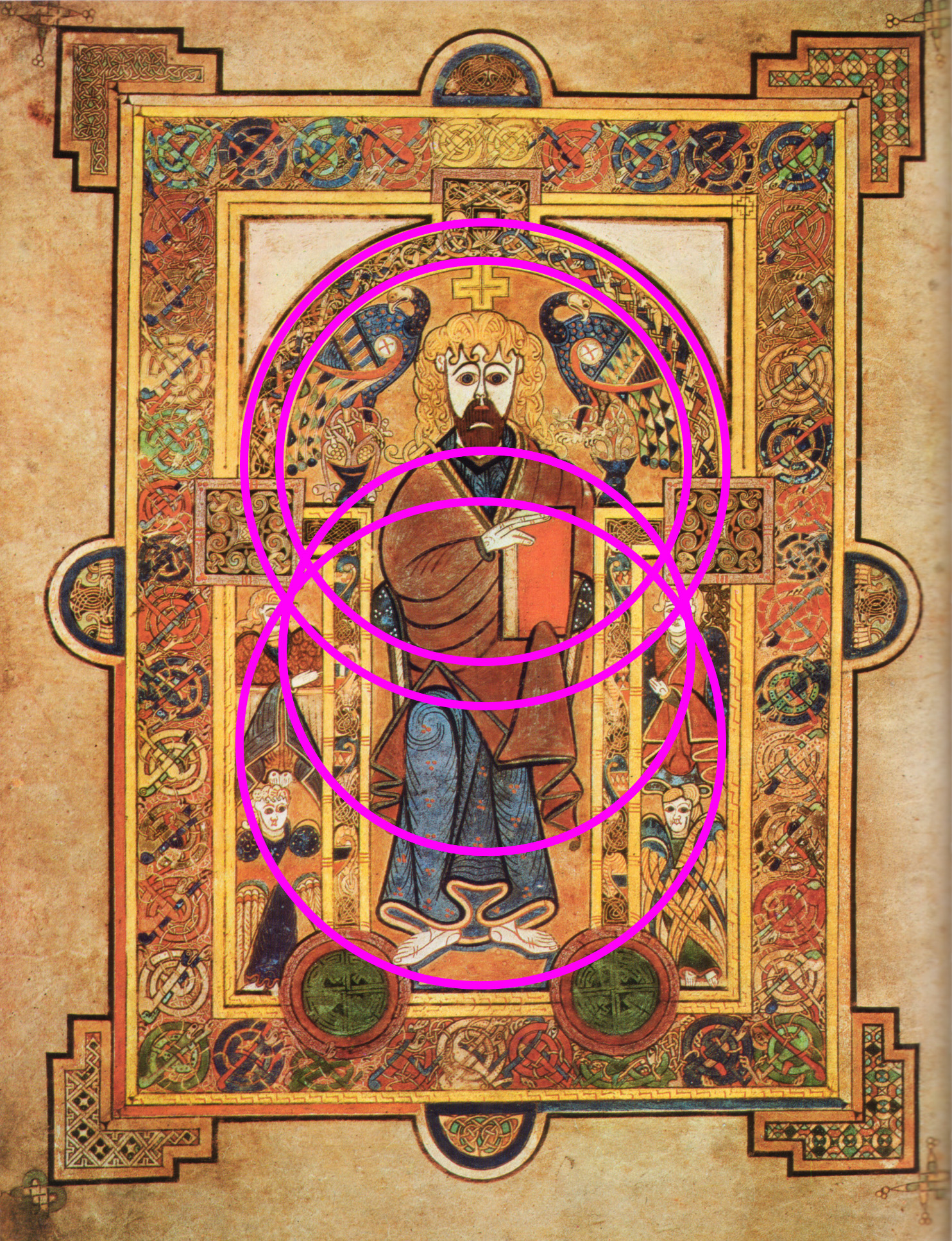
It is the Greek acronym coming from the term Jesus Christ Son of God Saviour. This makes the term ICHTHYS or ICHTHUS meaning ‘fish’ in Greek from the words.
- Iota (i), Iēsoûs (Ἰησοῦς), “Jesus“
- Chi (ch), Khrīstós (Χρῑστός), “anointed“
- Theta (th), Theoû (Θεοῦ), “of God”, the genitive singular of Θεóς, Theós, “God”
- Ypsilon (y or u), (h)uiós[11] (Yἱός), “Son”
- Sigma (s), sōtḗr (Σωτήρ), “Savior”
I’m leaving an extract from the original Wikipedia entry here because as you can see each word and letter links to a page containing greater meaning in itself . But the fish is symbolic as an image on a number of levels.
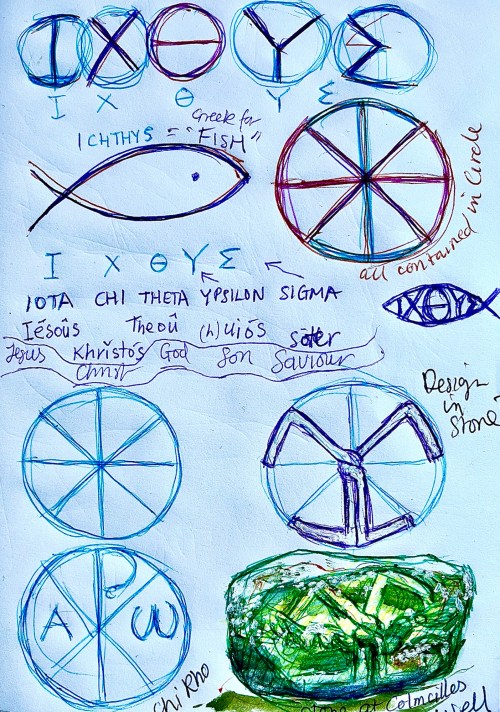
The fish is referred to in the Bible during the miracle of the loaves and the fishes and the casting of the net where many fish were caught, 153 to be exact (this is another symbolism ). This fish meaning is important also because Jesus arrives at the start of the astrological age of Pisces. But briefly here I’ll say that one of the ways of portraying the word alongside using a simple fish symbol was to overlap the Greek letters upon each other. This created a circle divided by eight. This was sometimes seen as being a circular loaf of bread that was marked with a division where the bread might be cut later for eating.
This had another symbolic connotation in the phrase where Jesus describes himself as The Bread of Life. These symbols are amongst the earliest used in the catacombs under Rome for instance and I was fortunate enough to see these carvings on the walls when I visited Rome . They come from a time before the image of the crucifix became synonymous with Christianity. Actually back then The Cruciform shape was seen as being too horrifying to use as an early Christian symbol. It would be like starting a religion today using an electric chair as its symbol. Could you imagine how preposterous that would be? But symbols have a way of evolving across time when they are so old.
So, these other geometric forms were the first means of conveying the presence of early Christian’s to one another. The gnostic cross was also one of the other earliest. Now when you see what I have written here you can begin to get a picture of how powerful a geometric form can be because it contains so much knowledge.
It is clear that teaching these forms using manuscript illumination had an educational purpose both to teach young apprenticed monk illuminators , geometry, mathematics, art, astrology, theology, greek and Latin reading , writing, calligraphy , paper making and bookbinding. And in displaying the work after it was created, passing on knowledge to the common people too. Geometric forms were also mnemonic devices to aid the memory with instilling in the mind the many facets of knowledge that would come from them. A picture tells a thousand words.
The Kells Crozier.
However the discovery for me that really took me by surprise was the story of ‘The Kells Crozier’ . This was found in a London solicitor’s office and given to the British Museum (Can we have it back please? ). This is a silver and copper reliquary containing a wooden staff believed to have belonged to the leader of the Columban monks, Columba, also called Colmcille.
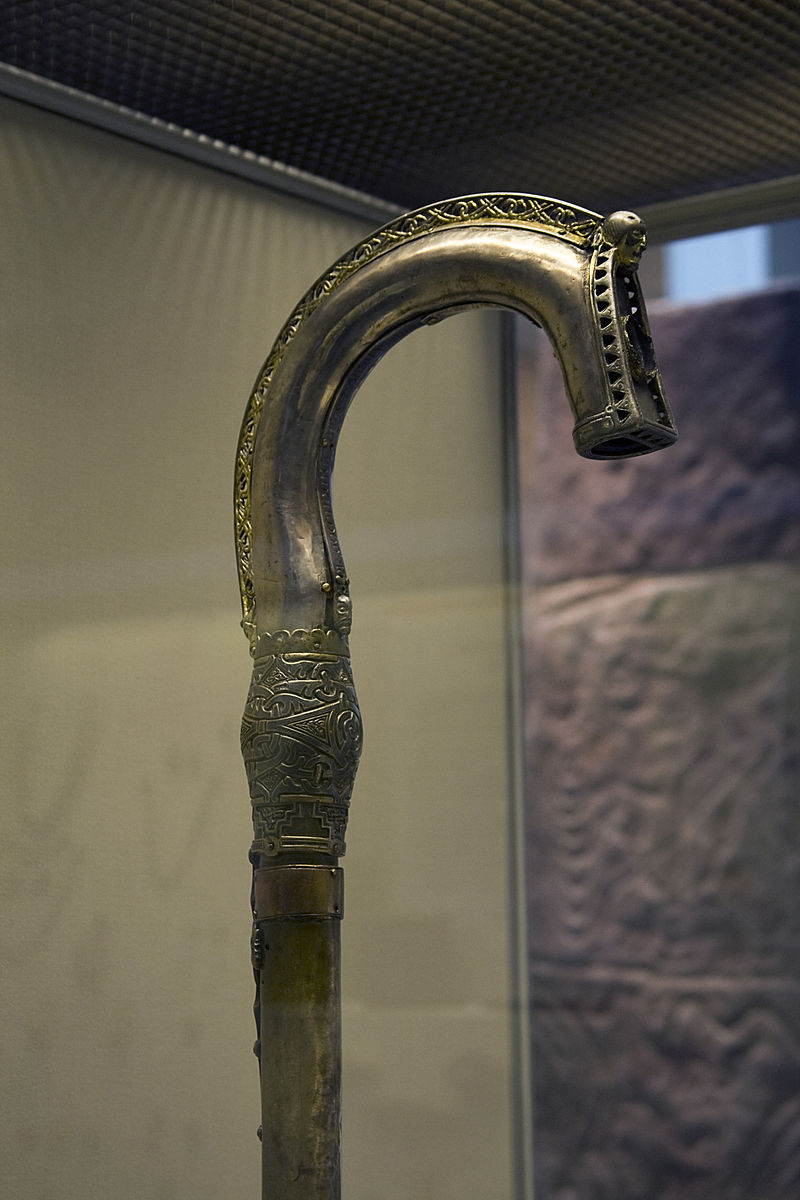
Information available says the object contains an inscription in old Irish…. But it also looks in part latin to me.
“ordo conduilis ocius do mel finnen”
It asks supplicants to pray for Cúduilig and Maelfinnén. I wonder how those names are translated? Could Maelfinnén mean ‘Bright Honey’ as in Mil Finn. And Cúduilig mean the ‘ lair of the hound’ as in Cú Dulóg or perhaps it’s simply the ‘Hound of Duilig’ the word Duilig sounds very like the word Damhliag which means stone house or church. Which is very interesting an idea because there is an important monastic stone house still intact in kells to this day.
These names loosely interpreted are believed to represent the craftsmen involved with The Kells Crozier. They sound to me like nicknames, or artists business names. The art and training business I run is named ‘Perfect Vision’ for instance. These entrepreneurs were also aware of the power of branding.
Apparently The Kells Crozier was made by a number of craftsmen over three different phases between the late 9th and 11th century AD. While the core is wooden, the crook is made of silver and the staff is covered in a copper alloy sheet which was later covered with silver mounts or knobs filled with animal interlace typical of the period. The curved crest of the crook is elaborately decorated with interlinking birds; a design of a human head is placed on the drop of the end of the crook the part that would be used to hook a sheep if it was caught in thorns or something like that . This is where the crozier would have once held some holy relics and precious stones that are now lost. Its length measures about 133 cm
The Crystal Pilgrim Returns To Kells : A Diary Entry
1/4/23
Today I went to Kells again to have a look more closely at The Well of Colmcille. This is up beside Ronny’s hardware on the old castle road leading out of the town. I was given directions there by Libby who works in the visitors centre in Kells which is a mini museum showing a replica of the book of Kells and Colmcilles Crozier. She was most helpful and knowledgeable telling me about various publications and ideas about the book and about Kells generally. She informed me that there is another well in the town too called St Ciaráns Well.
She warned me that the trail to colmcilles well was very mucky and she wasn’t joking. I found the gates entrance and the earthen path has literally become a stream of water in the wet weather of the day that was in it. I had to sometimes walk trammeled by the slippy edges on either side of this stream and I nearly fell a number of times.
However I’m sure that situation was created by the extremely wet weather and heavy rain we had been having all week. The roads I had travelled to get to Kells were often flooded.
Water was the theme alright… purifying cleansing and wet water….and it was raining the last day I was there too a couple of years ago . This inspired the imagery of the painting I did based on Kells and the ancient stone that is probably one of the original features of the well came into view as I made my way down towards the stream that seemed to lie in the dip of the well.
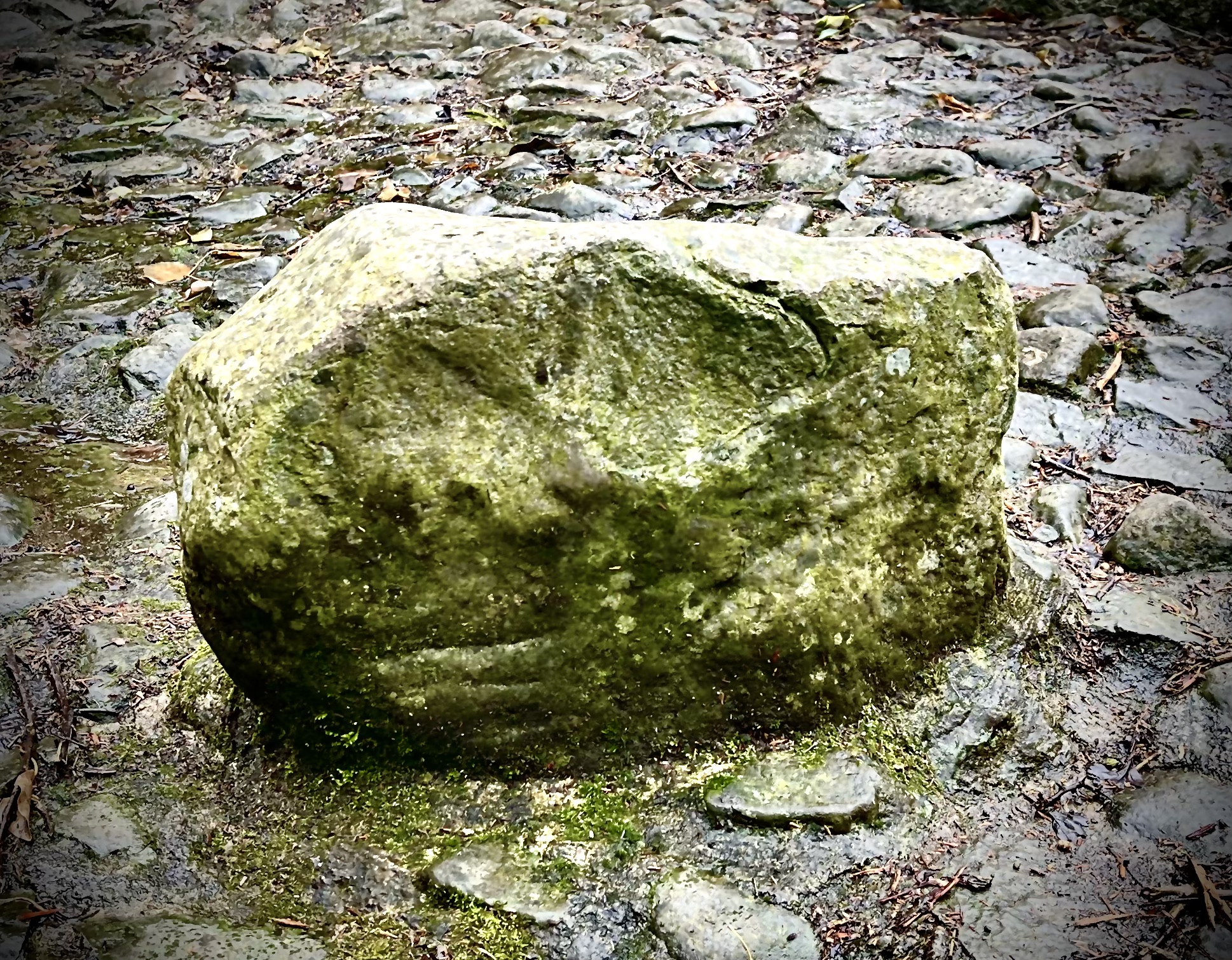
The Stone At Colmcilles Well
That stone I discovered had lozenge shaped markings in it and I wondered about its origins. Was it there from pre-Christian times? But then as I look closer I realised it really is a hooked cross of which one hook is damaged . Are we looking at a very early christian symbol not unlike ones found in the catacombs of Ancient Rome It is all built into a kind of gutter shape now surrounded by embedded stones with a miniature stone enclosure built around the source itself. All the lovely trees had been cut back to three foot high all around the areas which was partitioned off with a wall. This took away from it more natural appearance. However I found that the well had a calm atmosphere around it and I stayed a while until it started to rain again. I noticed some other older, perhaps more pre-Christian Stones, also worked into the newer more modern wall that was there. They too seemed to have markings in them hinting at the pagan origins of the wells history.
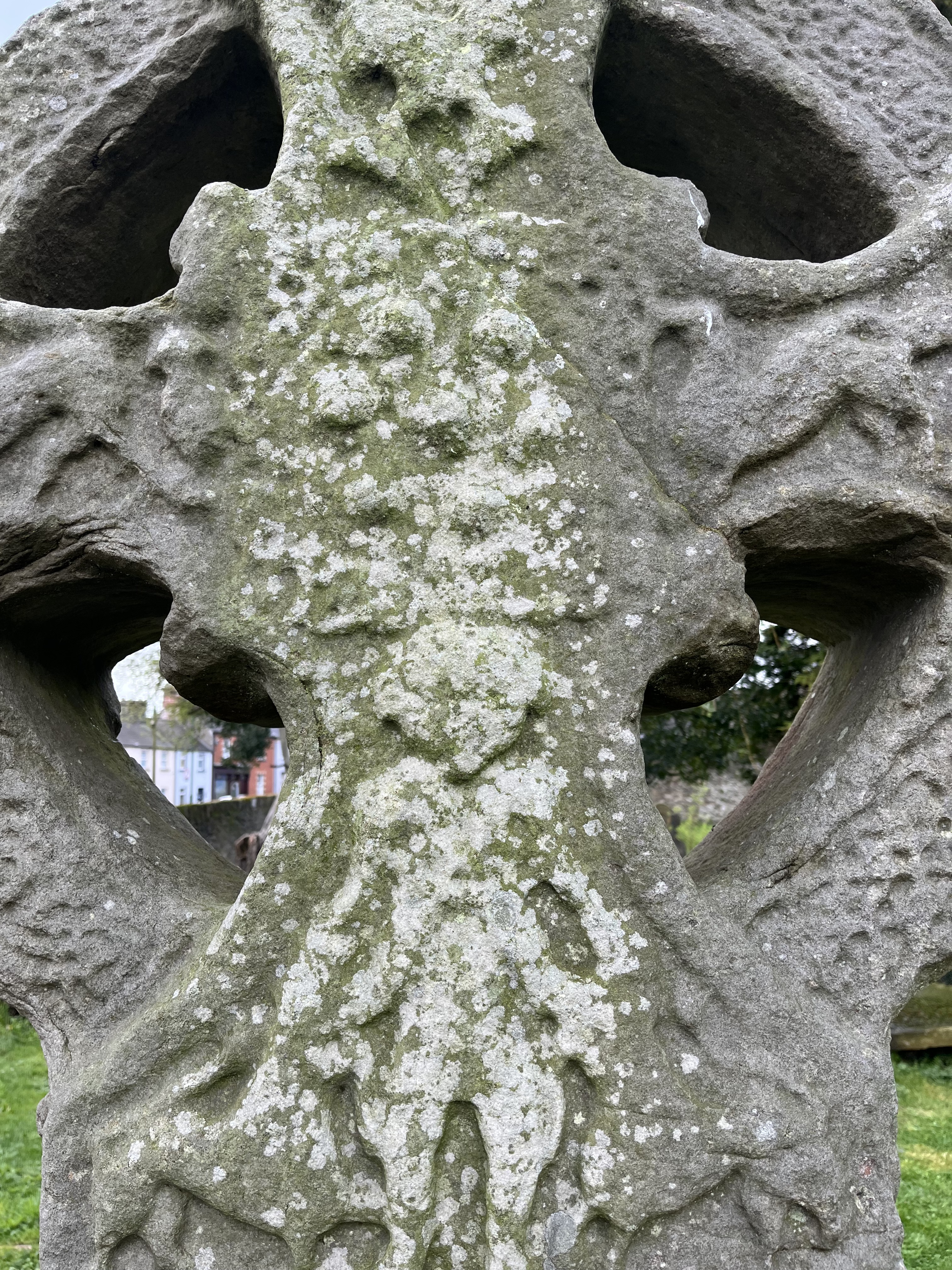
Kells is full of features including the high cross at the visitors centre and the three high crosses one of which is unfinished in St Columbas churchyard. It stands in what would have been the grounds of the Monastery of Kells. This also features a round tower which has lost its conical roof and around the back of the churchyard outside in its present day grounds stands the impressive scriptorium which looks like a complete stone house which also has a stone roof . There are a number of round towers between this here in Meath and Louth.
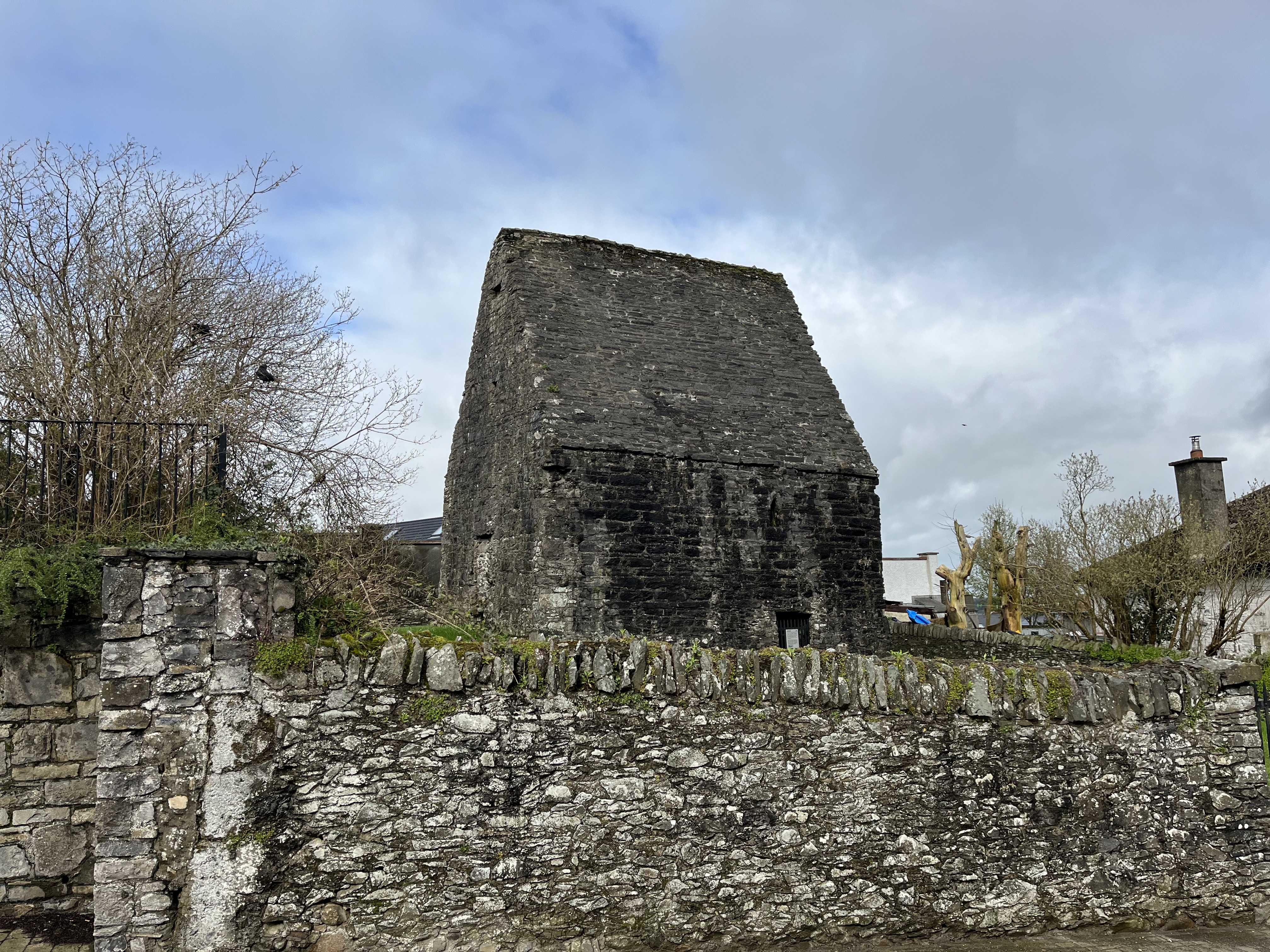
The Scriptorium?
The proportions of this stone house building are very satisfying to look at and I wonder if it made use of a 3:4 proportion in its design. It’s a very large and simple house form but its roof is made also of corbelled stone rising inwards towards the watershed of the apex. I have come across another house from this period with a stone roof in Louth it’s called St Mochtas House. There is also St Kevins kitchen in Glendalough , the Gallarus oratory in Dingle and There are very small and narrow windows in these type of buildings roofed in stone corballing which would appear to make it far from ideal to be a calligraphers or illustrators art studio. This triangular appearance of the gable end of the scriptorium made me think again of the geometric significance of the triangular form to the mind of the early Christian Irish artist. see more about these type of buildings here https://www.askaboutireland.ie/learning-zone/secondary-students/art/irish-churches-monastic-b/early-monastic-churches/
Notes On A High Cross
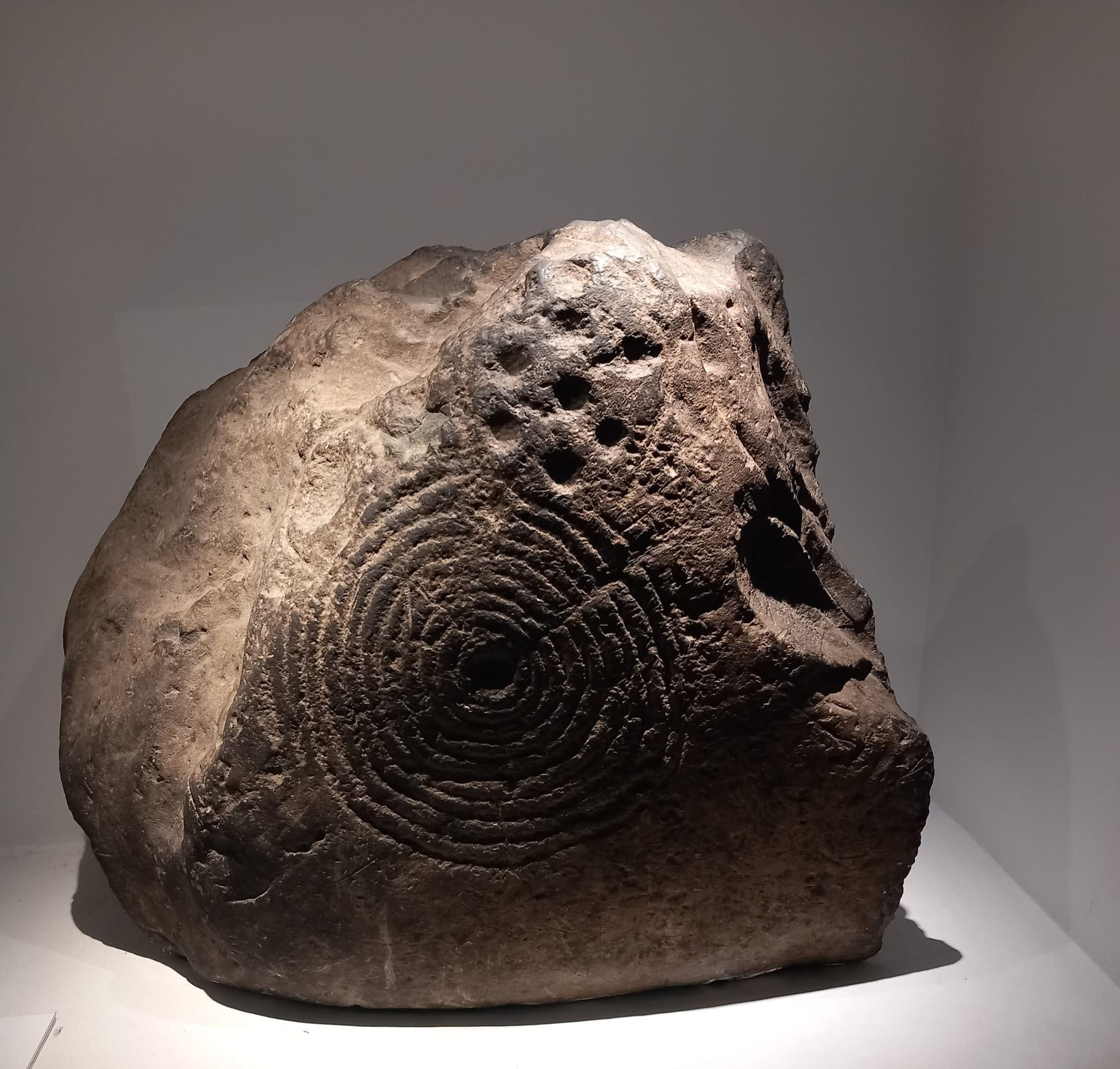
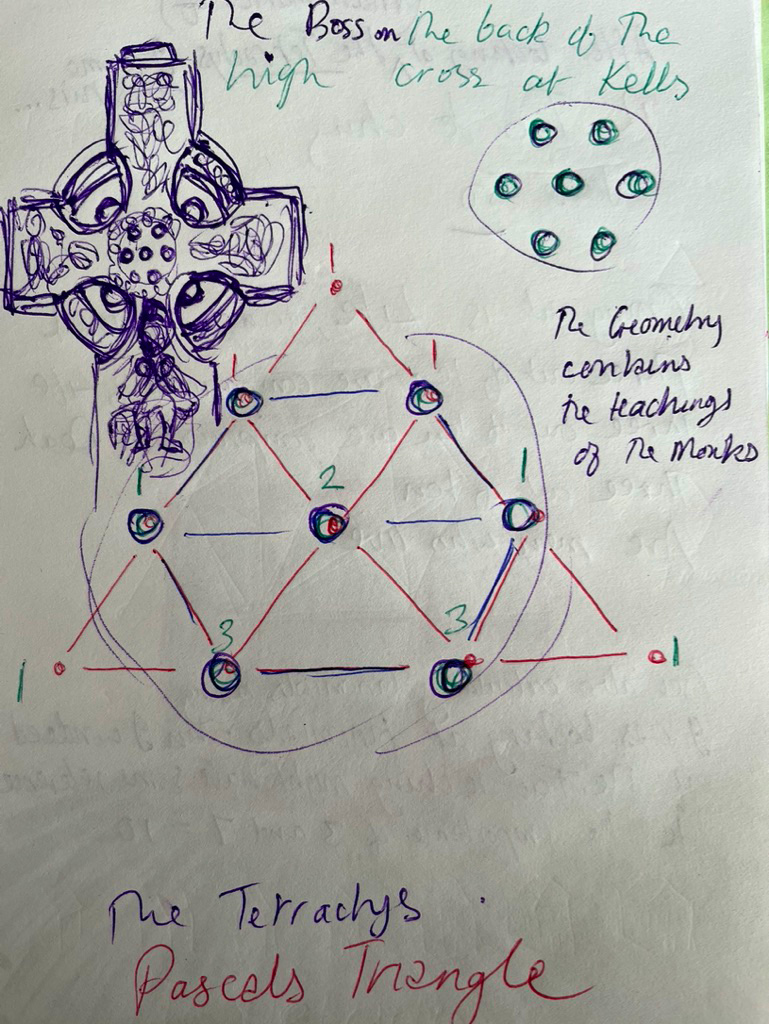
One of the crosses in Colmcilles churchyard has a very interesting boss design which I refer to in my notes shown here. Its mathematical symbolism and hexagonal form are very potent. There is so much to see in Kells and I haven’t touched upon the designs on the high crosses much at all. But I must try and concentrate upon the staff or rod symbol here.
From The Rod To The Lance
Another manifestation of the rod is as a spear. In the Arthurian legends and its connections to Celtic legends, there is the story of the spear of Lugh which is said to have magical powers in battle. It was impossible to resist once thrown it was made from the yew tree ( an Crann Iúir ). It had to be kept in a cauldron of water to stop it from igniting as it was so powerful, it was known as the “Areadbhair”. It is also called “The famous Yew of the wood”. It was believed to be alive and when battle was near it would roar and fire would flash from it.
These qualities reappear in a number of ways in Arthurian myth. In Chretien de Troyes story it is the Lance of Longinus that is said to have been used to wound The Fisher King Amfortas.
“…out of a room came a youth holding a white lance grasped by the middle; and he passed by between the fire and those seated on the couch. And everyone present could see the white lance with its shining head; and from the tip of the lance-head oozed a drop of blood, a crimson drop that ran down right to the lad’s hand.”
The above is clearly a reference to a pagan ritual that has deep connotations and is concealed in the grail legend it is taken from. Amfortas is said in some accounts to be wounded in the thigh by the spear but in others accounts he is wounded in the groin. This refers to the land that is made impotent when the king is maimed. An idea that comes from the earliest times in celtic legend and discussed elsewhere in these essays.
A Gnostic Understanding Of Events Surrounding The Image Of The Lance At The Crucifixion
The Lance of Longinus is the name given to the spear that wounded Jesus on the cross and there has been much speculation about this story. So called heretical tradition has it that there was a plan to try and revive Jesus after the Crucifixion that failed. It was customary to break the legs of the crucified to hasten their death. But Jesus died quickly and there are a number of reasons given for this. One was that he was given a potion when he was administered a drink on a sponge that was lifted to His mouth that appeared to quicken His death. This meant that when they came to break His legs there was no need to. However…. and as if to add further damage…. in a way perhaps that people do not think about much, the centurion who is given by tradition the name of Longinius, pierced His side to prove that He was in fact dead before His deposition from the cross.
This simple act meant that blood and water flowed from His side . This is medically significant (blood and water can’t flow from the body after death) . Circulation stops when the heart stops pumping blood. So the flowing of blood and water would indicate that Jesus was still alive even if he did not make a reflex movement when pricked by the spear which would have been sufficient a sign of death for a roman soldiers understanding . However when he was pierced, the chemical he was given to conceal the fact he was still alive, was negated and lost when it flowed out with the blood and water (or plasma ) when it streamed out of Him. And so tragically the plan failed and they were not able to revive Jesus as they hoped to do . That is the story of this terrible moment for humanity when they crucified The Son of God. What I have written here about the lance is explored in numerous book on the subject.
I mention this early Christian account because Interestingly at Kells, which has to be one of the most charged centres of early Christian art in Ireland … images of the pilgrims staff , the Lance of Longinus and the crozier abound on its high crosses there.
Firstly a particularly potent and controversial image appears on in the cross in front of the interpretive centre.
These images deserve a fresh eye. The panel that caught mine is the one of the disrobing of Jesus before the crucifixion. this appears on numerous crosses in the Boyne valley including Muirdeachs Cross and The West Cross at Monasterboice. . I will furnish a number of images here to illustrate this

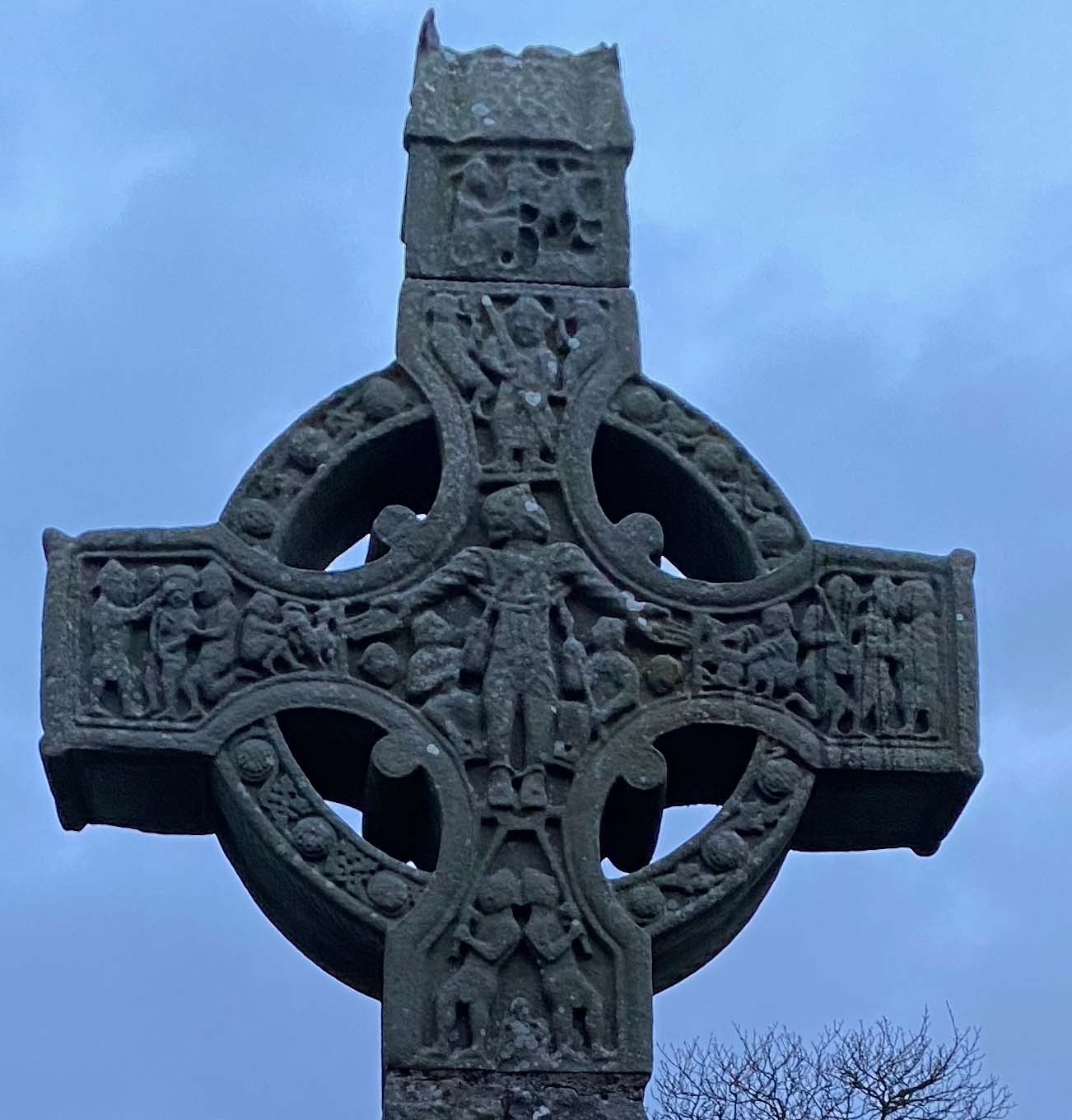
Expressive Power
In another scene related to the crucifixion the event is clearly being depicted symbolically as a rape. The diamond shape of the garment being cut open by the Roman auxiliary with his sword not unlike a doctor cutting open the clothes of a trauma victim with a scissors. The sword penetrates the yonic shape of the layered garment in a most priapic manner. Its allusion is undeniable. On a deeper level the feminine creative aspect of Jesus as a rabbi and philosopher who taught his followers goodness, the perils of evil and morality, extols this feminine aspect in his appearance. With a gift for portraying principles, their meaning within his parables and the perfect living example he embodies of perfect love, He is being here portrayed as being brutishly cut away by the distinctively bearded and unfeeling soldiers who function in a macho-aggressive, mechanical and dispassionate way in the presence of pure holiness. A holiness that they are completely unaware of and incapable of perceiving. Jesus appears to be holding a staff at this moment.
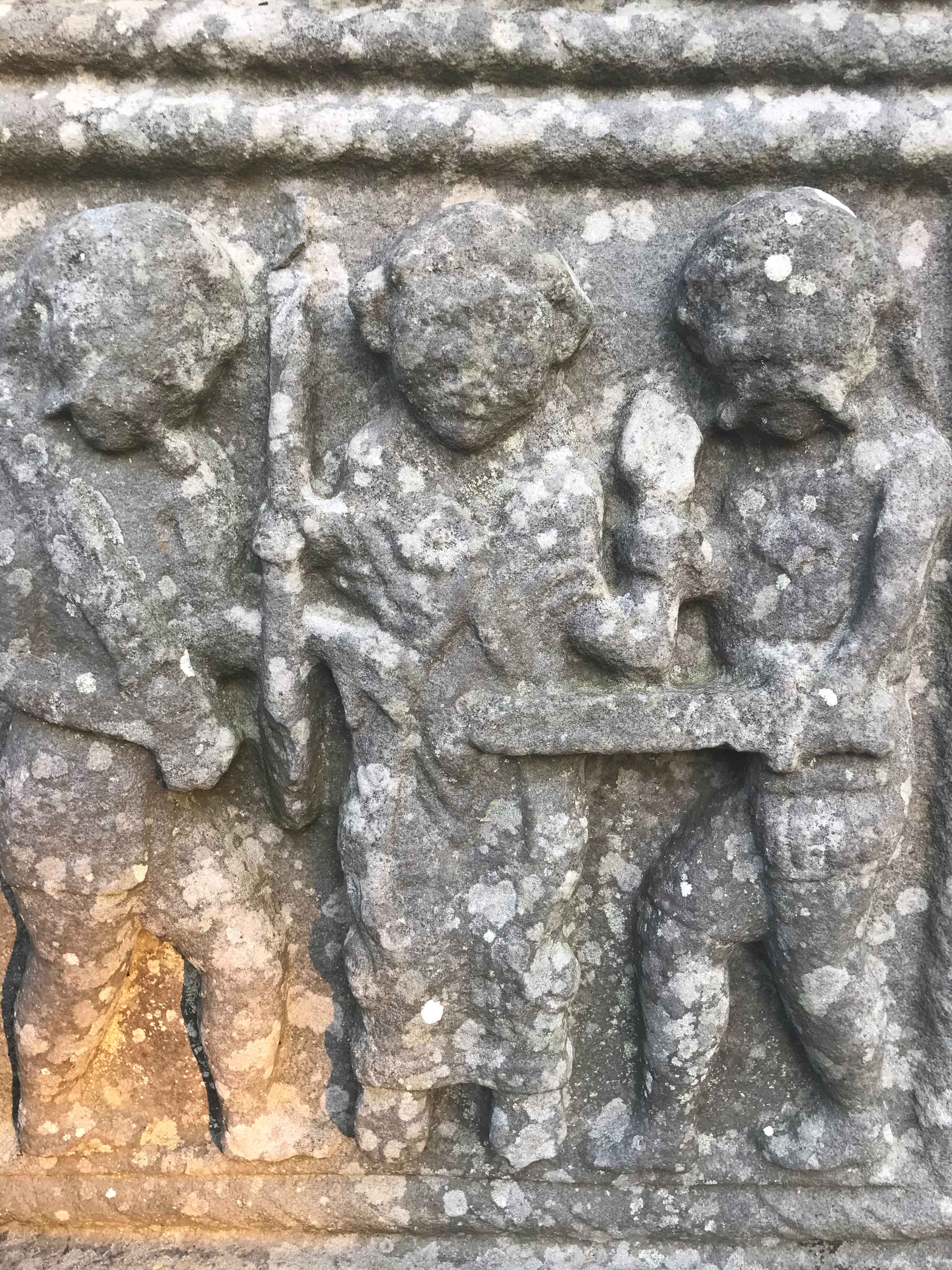
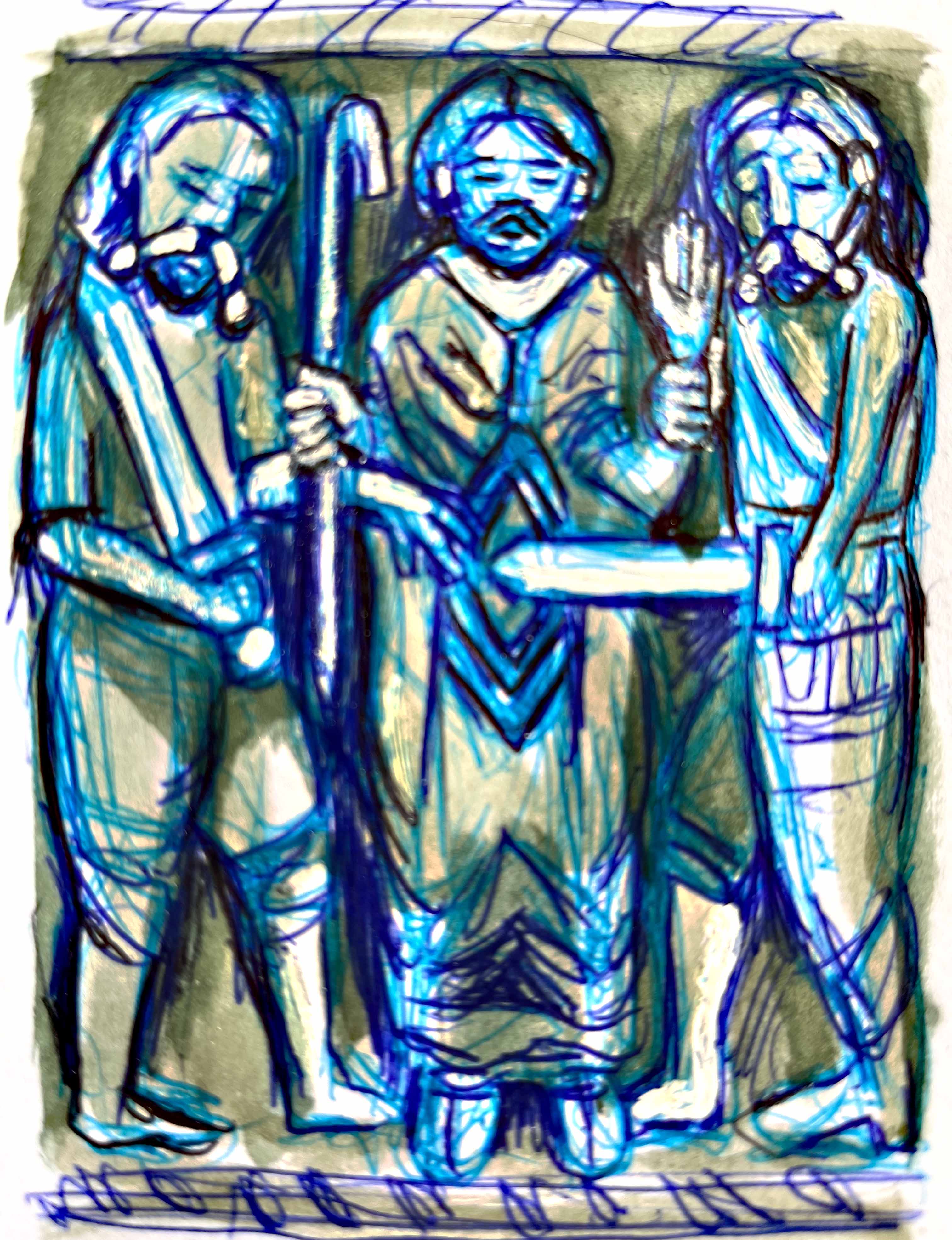
The sculpted layered form of the Hara of Jesus being opened as he is disrobed, reminds one of the images of similar broadly carved figures of Sheila na gig which are also reminiscent of the Vesica Piscis form itself . The sculptor that made this image conveys most powerfully a depth of understanding that acknowledges the symbolism of the event that is being immortalised in their stone rendition. The powerful sacrificial aspect of what is taking place is understood completely and depicted in the accepting pose of Jesus whose horrendous abuse is framed as a template like one enthroned, mimicking both the upper panel of the last judgement and the crucifixion scene.
The Romanesque style of these works that are a style conveyed that seems to have forgotten the idealistic and technically much more proficient forms of classicism that preceded it by centuries, compensates greatly with its expressive, raw energy.
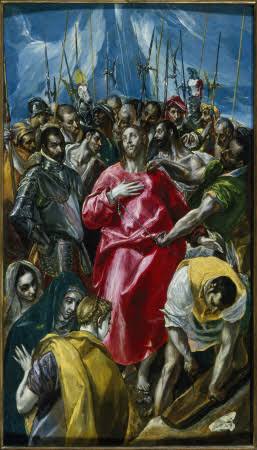
The chiselled forms declare more mystical associations about the idea that sexuality itself is holy and sacred and that the world is dangerously exploitative of it. The unorthodox early Christianity being conveyed here is alluding to our sexuality as a vessel of that holiness. That creative power that Jesus contained is seen as feminine and being issued from God. Jesus claimed that he was The Morning Star which in Roman pre-Christian belief is Venus the Goddess of Love. This compensates also for the obvious absence of any emphasis placed on the feminine aspect of God in a bias contained in the New Testament. The sculptor here consciously makes a statement about this in their work. The bias against the feminine spirit in the narrative of the New Testament must have appeared strange to early Irish converts who acknowledge feminine divine powers wholeheartedly and often above masculine ones in their older belief system.
We might correct this bias if we see the image of the Holy Spirit as symbolised as a dove when mentioned in the texts as being a representation of that Holy Divine feminine Aspect of God.
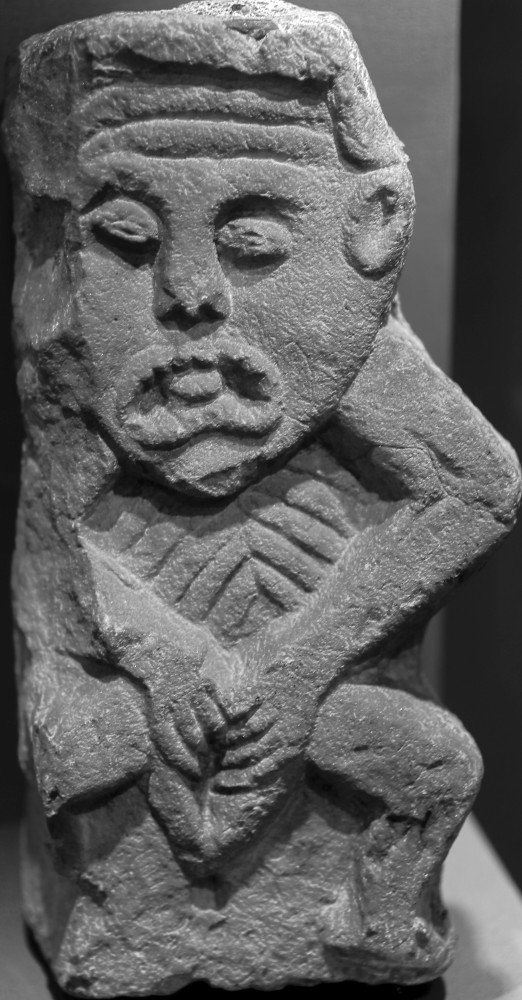
The Symbolism of The Vesica Piscis and The Image of Sheela-Na-Gig.
Here in this image Jesus holds a staff or Rod representing his own heavenly power that he chooses not to use against these aggressors. But it also reflects the scene when he is stripped of his robes after having being mocked as Christ The King by his torturers when his was given the crown of thorns and a rod for a sceptre then presented to the people in the what became the ECCE HOMO genre of artistic portrayals.
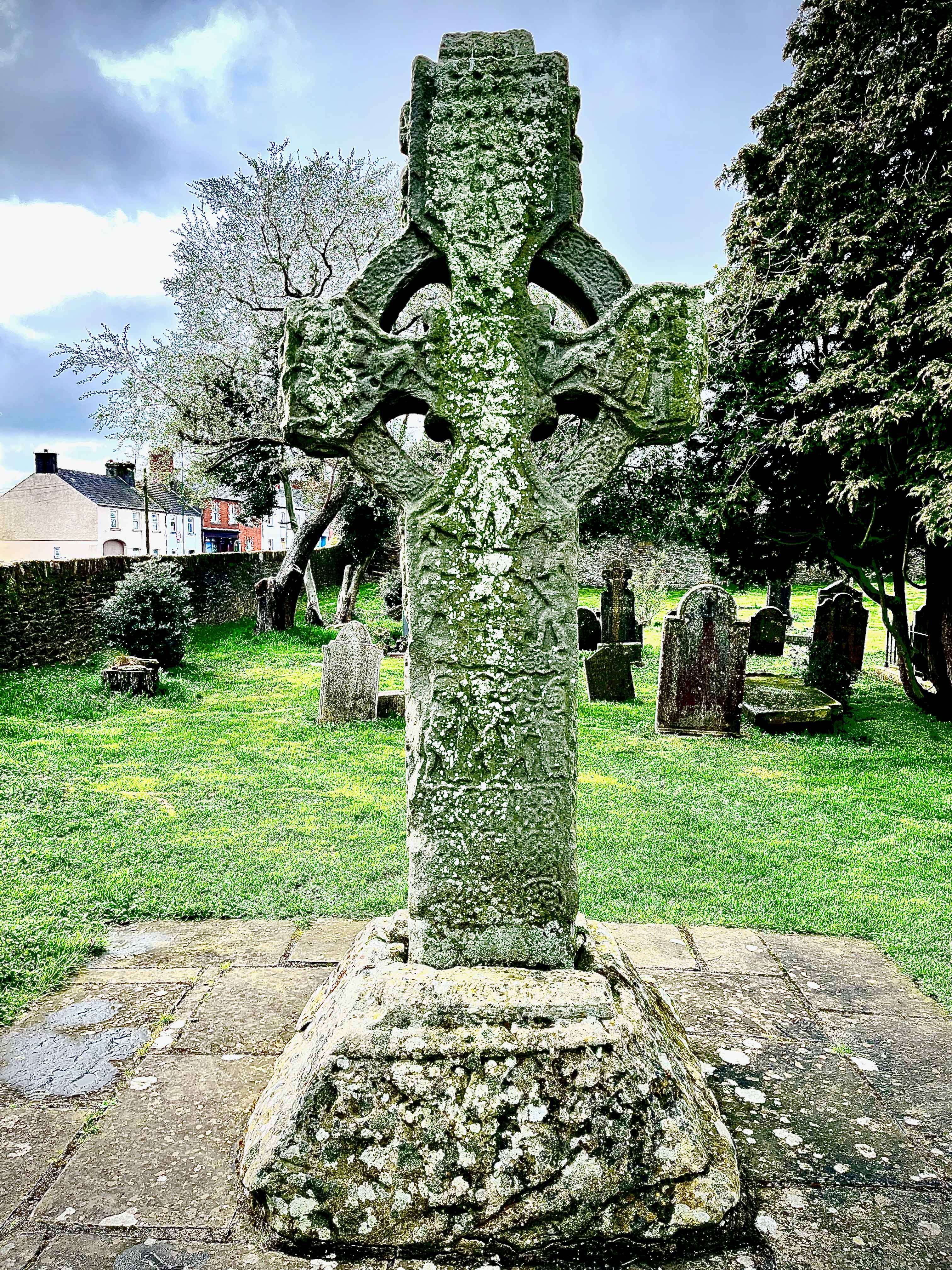
The image of the lance and staff appear symbolically side by side at the crucifixion. Here one staff holds aloft the sponge containing the sour tasting water or vinegar as it is referring to in the text , while on the other side the lance pierced his side. The pairing of these events together may contain the idea of the. events importance as I have stated already. But what proof can I offer? It is important that the crucifixion is seen to fulfil the Old Testament prophecy of Isaiah that states that “not a bone of his shall be broken”, because once Jesus was shown to be dead by the Centurian lance there is no need to break his legs as was the horrible custom during these public executions to hasten death, particularly at the passover when jewish traditions had to be observed . This is another reason why the event is remembered. In order to show that aspect of the death of Jesus through the prophecy of Old Testament scripture. This means that Christianity legitimately can claim to supersede its Jewish inheritance because its older prophecies were fulfilled in the New Testament.
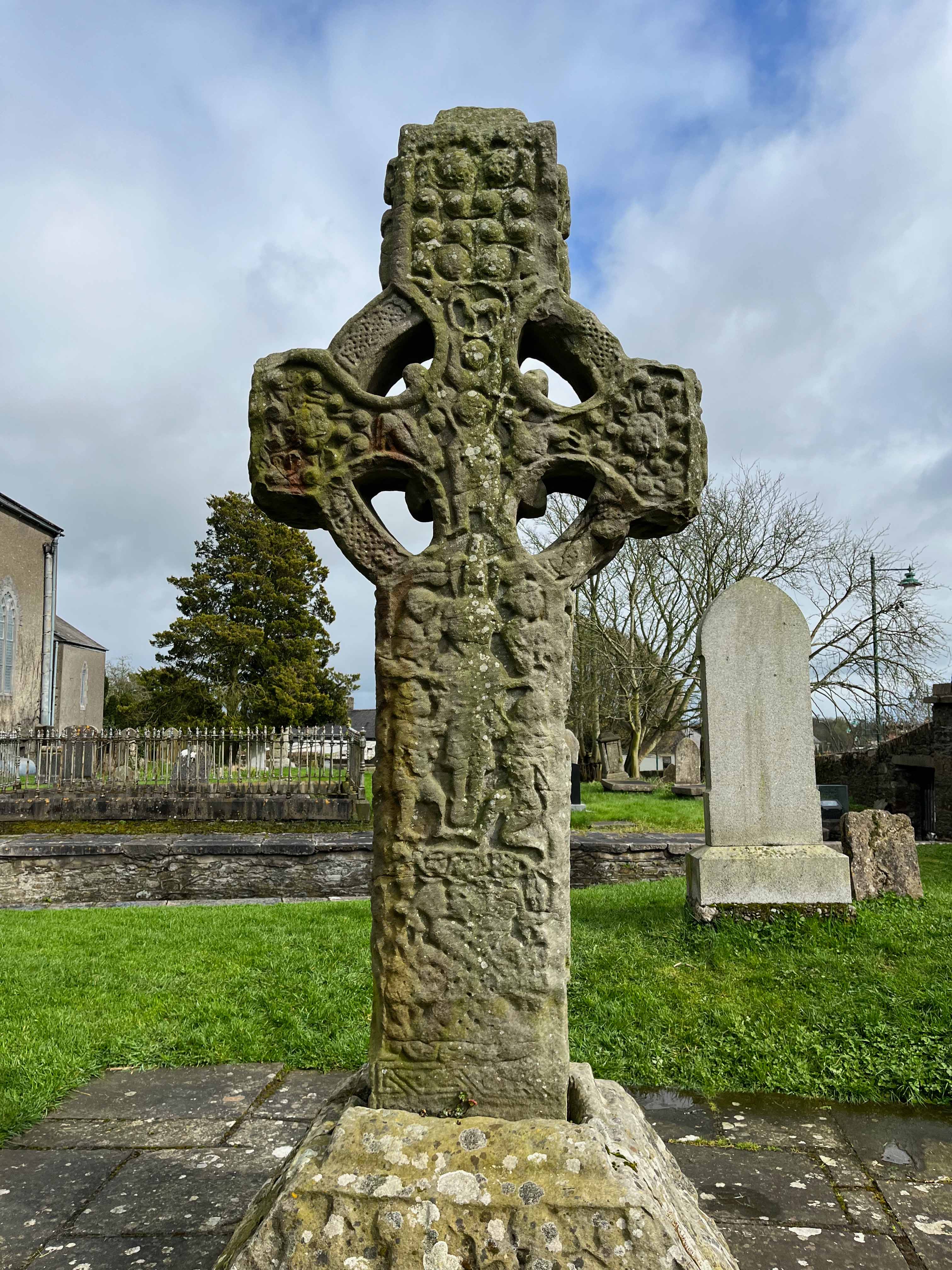
On another side of the same cross there is a panel that shows two staffs that cross each other in the design making an X form. I have already covered the importance of this form in my chapter on “Justice at Mc Arts Fort” and Belfast. Here the X image shows in art a desire to be wary of the relatively new orthodoxy. The X shape can signal an acknowledgment of gnostic beliefs that Augustinian teaching hopes to expel from the church in order to be more accessible to a larger following less familiar with the controversial and pagan influenced absorption of more mystical depths behind religious belief. These beliefs were driven underground by Rome who wished to escape the influence of any mystery cults or heresies as they called them, such as the Pelagian and Mithraic heresy’s that found their way into early catholic belief systems and which threatened to undermine agreed dogma that the orthodoxy professed.
The Abuse Of Spiritual Symbolism For Political Power.
The Lance , the staff and the wand often feature as important features in spiritual narrative. This narrative is not always created for the sake of goodness as we can see in numerous historical accounts. It may have a negative spiritual purpose and this is what came to the mind of Hitler when he studied the object as an aspiring young artist . He was obsessed with it and mentioned it in his book Mein Kampf . He believed that the lance had enormous power and could bestow this power unto a warrior who held it.
He wrote that the Imperial Insignia “were still preserved in Vienna and appeared to act as magical relics rather than as the visible guarantee of an everlasting bond of union. When the Habsburg State crumbled to pieces in 1918, the Austrian Germans instinctively raised an outcry for union with their German fatherland”
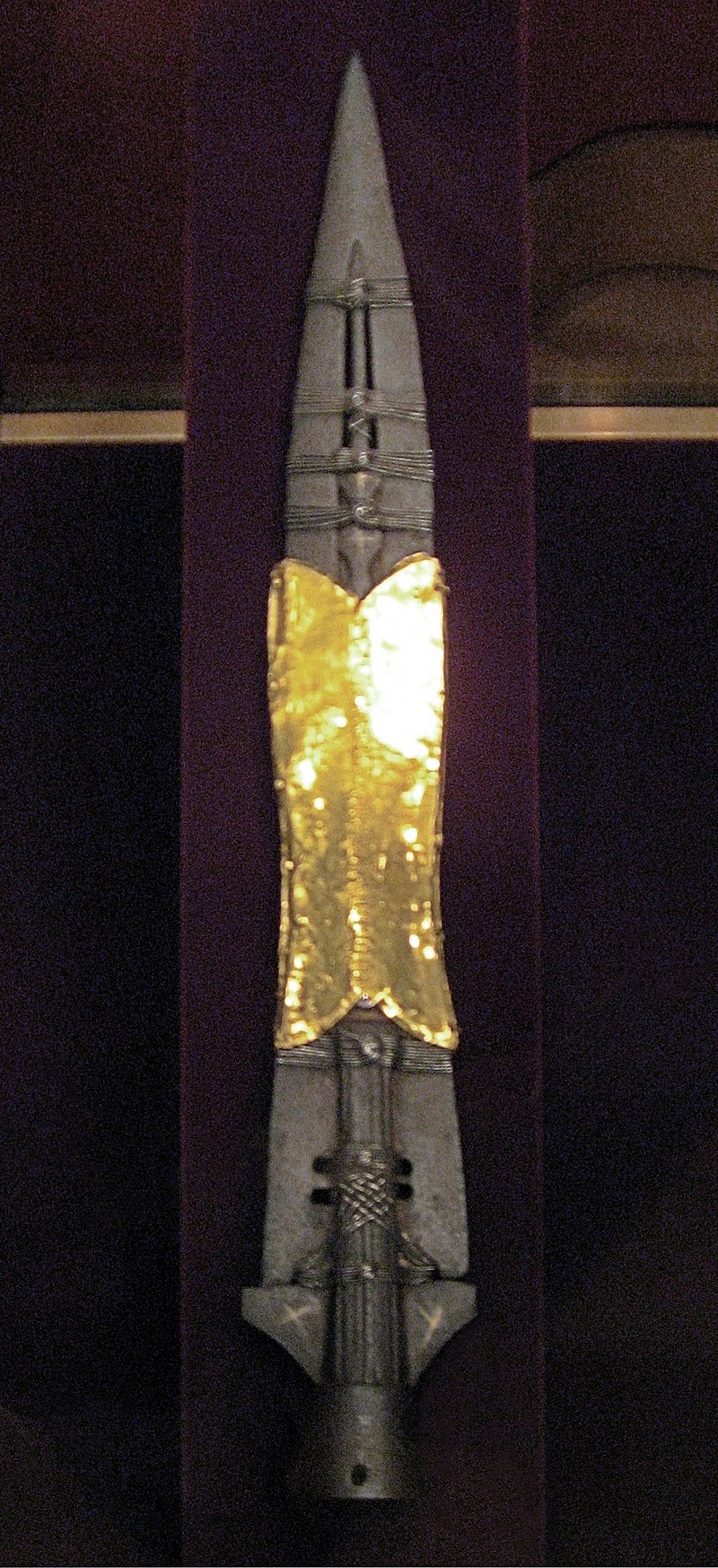
During the Anschluss when Austria was annexed, Hitler had the Spear, which was housed at the Holfburg Palace in Vienna, removed to a special site for his own purposes . Those purposes can only be understood if it is accepted that the inner circle of Nazi’s were follower of the occult and they believed the legend of the spear , because of its associations, they believed that it had psychic power that could be exploited using occult rituals and magic. The spear and the Nail built into it, is today believed, after being carbon dated by scientists, to be dated to approximately the 8th century
Occult Use Of Objects Of Psychic Power.
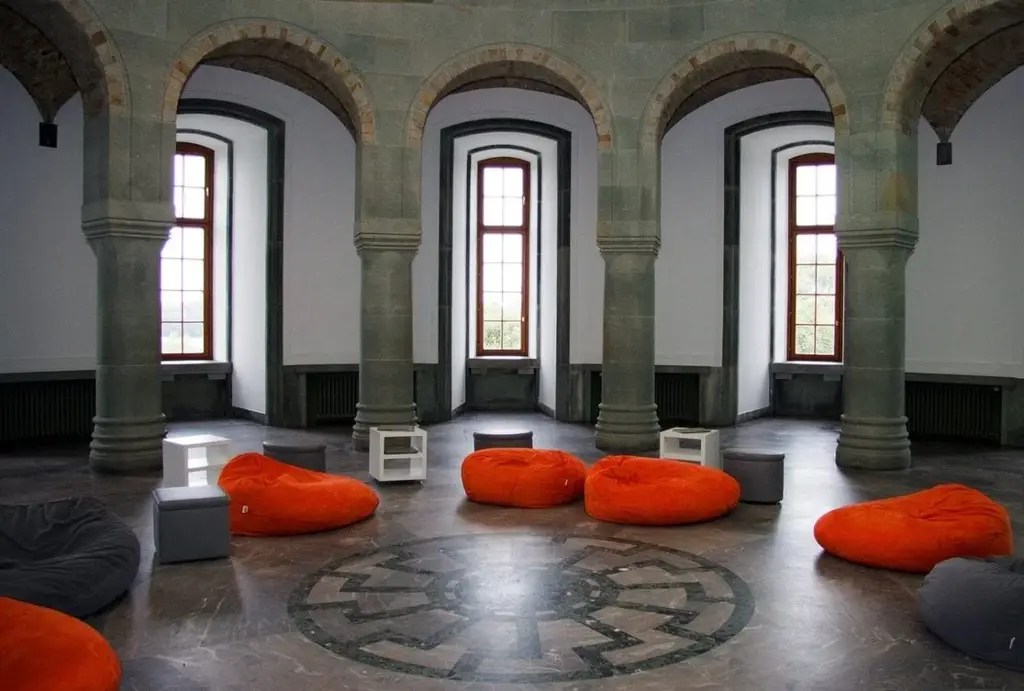
This deeper aspect of this higher corp of Nazi Leaders involvement with the purposes of evil were left out of the Nuremburg Trials. It must have been decided that the public simply would not be allowed to know the full extent of the activities of occult groups that were deeply involved in bringing about the circumstances within which war could occur as they are working so hard to do today. If they did they would have to admit that magical thinking could influence the events of modern history and this would also mean exposing the network of interconnected secret societies such as the Thule Society founded in 1918 by Rudolf Von Sebottendorf, the occult group that used magic to help the inner circle of the nazis. These psychic means were used to help gain scientific knowledge that promoted those ideas and activities. Rudolf Hess and Hans Frank were also members of that group.
Not acknowledging this fact was a tremendous mistake because it allowed these networks to continue to exist and influence many other acts of destruction. Few people would have liked to admit at the time that the Rocket Developments that led to the V 1 and V2 and early American Missiles for instance, used their occult network to share information across the Atlantic as in the case of the exchange of information between Jack Parsons and Verner Von Braun and the use of their research.
Parsons was the leader of the agape lodge, an OTO occult group in Hollywood which he led under the guidance of an ongoing correspondance with MI5 Agent 666 Alistair Crowley . He was regarded as a liability when it was found out by that had been corresponding with Von Braun. The notorious OTO society of which Crowley was the controlling founder until his death had strong links between Germany and America.
SS Major Wernher Von Braun was brought to America as part of the now infamous Operation Paperclip and went on to become chief architect of part of the NASA team that developed the Apollo Saturn V Rocket. Von Braun developed three educational movies with Walt Disney to promote his vision of the future space age. These movies were played continuously at the pentagon until all staff had seen them so that they could be ‘on message’.
Secret societies and their occult activities are presently forming the hidden backdrop to the successful warmongering that is currently taking place. We can be sure that their true purposes are not for humanities benefit. The question that is being raised is why has humanity in fact allowed these relatively few individuals so much power? Because when you examine history it is plain to see that it is a small number of people that are controlling the largest events. Already I believe World War Three has begun thanks to their machinations. Who in their right mind would want war except those possessed by evil. Evil druids…. who wave their wands and have cast most of humanity, it seems, under their spell.
Tammuz And The Shepard’s Staff.
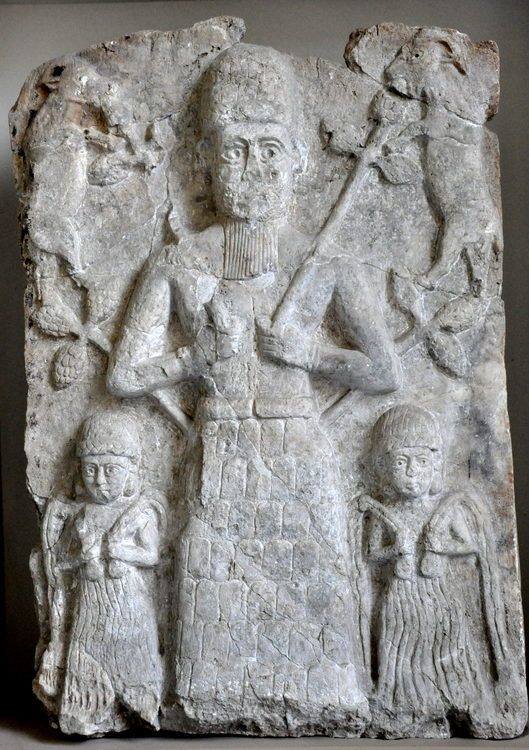
The image of the Shepherd’s staff can be traced even as far back as to the Sumerians and their god Tammuz the Shepherd (also called Dumuzi or Damuzid) who is mentioned in the old testament, and there are numerous references to him there . But his origins and some of the text from the Old Testament draw their knowledge of him from Sumeria where he is portrayed as a dying and rising God , the consort of Innana who rescues him from the underworld where he is being tortured . He is the god of agriculture and he is portrayed in their iconography with a rod or staff. When he died annually his death was mourned primarily by women who planted short lived small potted gardens that would die in the summer heat and revive once the blast of the season’s sun finished in autumn.
From the earliest Christian iconography, Images often depict Jesus as the good Shepherd as in “The Good Shepherd from the catacombs of Priscilla”. This comes directly from John’s gospel. and perhaps may also refer to this quote…
“Before him all nations will be assembled before him , and he will separate men from one another as the shepherd separates sheep from goats. He will place the sheep on his right hand and the goats on his left”
Matthew 25:32-33.
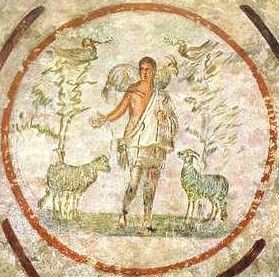
As an image it seems to inherit the earlier reference to Tammuz in its meaning despite the old testament regarding Tammuz as a false God.
I fear that the days of this positive meaning and its symbolism of what the shepherd’s staff (that came often to symbolise sainthood and pilgrimage) are under threat as the world hurtles towards insane materialism , warmongering politics and an excessive and dangerous embrace of artificial intelligence.
“I am the good shepherd ; I know my own and my own know me.”
John 10:14
Sean O’Dwyer April 20 2024

 THE CRYSTAL PATH